
Digital Marketing Solutions Summit | Forum Events Digital Marketing Solutions Summit | Forum Events Digital Marketing Solutions Summit | Forum Events Digital Marketing Solutions Summit | Forum Events Digital Marketing Solutions Summit | Forum Events

Posts By :

Stuart O'Brien

Market research in 2022: What to expect

Following a year of disruption in 2020, the seeds sown by the pandemic began to grow in 2021. Brands have recognized the need to understand constantly changing consumer behavior and sentiment, which has brought technology-driven market research and automation to the forefront.

So, what does 2022 have in store for the market research industry? What lessons can be learned from 2021, and how can these create real opportunities for consumer insights moving forward? Frederic-Charles Petit, CEO at Toluna, a tech company operating in the market research space, explains what next year will bring to the sector, including specific industry developments that will be key to progress…

Adaptation to a multi-dimensional society and individual

A key trend we’ll see in 2022 is how market research keeps pace with innovation alongside a rapidly changing, multi-dimensional society. Research will need to address the diversity in populations to truly embody being not only nationally representative, as the term is historically defined, but to capture the diversity of the ubiquitous consumer. Hyper-segmentation will become vital as research must move from simply defining key attributes of a person—such as age, social class, wealth, gender and the like—to create insights that are uniquely relevant to a consumer as an individual. Research needs to follow the complexity of society and consumer behavior so that it can deliver the information brands need to make key decisions in how they market their products and services.

Technology, driven by innovation in artificial intelligence, can capture this complexity—and market research organizations must harness this power to deliver truly agile, responsive insights about consumers that enable brands to remain relevant to their customers. That’s why, at Toluna, we’re boosting our investment in technology—which has always been at the forefront of our research platform—by 40% next year. We want to enhance our capability to continue capture the complexity of a multi-dimensional society, at scale, on demand, and in real-time to provide detailed, specific insight to brands on their consumers. We look forward to working with our clients to write this new chapter for market research.

Acceleration in the democratization of research to build and execute truly consumer-centric strategies

As we create superior ways to curate detailed and complex research on consumers, the industry must focus its efforts on the democratization of research. There’s a common misperception in that many think the democratization of research means the simplification of insights. This is not the case. When we say democratization of research, we mean making detailed data available in a simplified manner and in a seamless way to any business or any brand.

2022 will be the year to truly drive democratization because the technology is there to enable it. In the 21st century, you do not need to be a research expert to do this. The most junior members of an organization’s marketing team should be informed by easily available research that they can interact with, respecting the integrity of methodology, but at scale—and this is what we’ll see come to fruition next year. We’re currently in a situation where the everyday consumer has access to more data than, for example, a brand manager. They can simply go onto Google or ask their friends for their opinion online on whether they agree with something or what their favorite movie or outfit is. Why? Because there’s still this notion that research, in the B2B market, is for experts.

We’ve witnessed a democratization of consumer opinion and user-generated content online, but this has yet to be replicated in the business world. In 2022, as research continues to be technology-driven against the backdrop of constantly changing consumer sentiment, the industry must democratize research within the enterprise, giving marketing and brand teams the ability to access automated research at scale that can inform key decisions.

The multifaceted consumer – how market research must respond

Today’s consumer is complex and multidimensional. Real and relevant insights are no longer solely about a person’s geographic location, job role, or opinions on societal changes. It’s about understanding that a consumer can have several different “individualities.” For example, a person can be passionate about sustainable living. They might grow their own food, re-use plastic, and drive a Tesla, while, at the same time, enjoy holidaying in Barbados—which involves traveling thousands of miles via plane, one of the world’s biggest polluters.

As we move into 2022, the question becomes, ‘how can we reflect these different and complex facets of the consumer in research?’ The industry must focus on how we can give organizations the ability to capture three, four, or even five dimensions of the same individual or group of individuals. This is especially important as we move into the next generation internet—a 3D sequel to the internet called the Metaverse which has the potential to revolutionize the way we shop and the way brands market their products. How does a research company do that? It’s about delivering hyper-segmentation, hyper-personalization, at scale, and in real-time to enable brands to deeply understand and empathize with their consumer to deliver products they truly want.

 Looking ahead

There’s no doubt about it, the industry is set for profound transformation in the next year. Powered by automation and technological innovation, we’ll see market research companies change from simply asking questions to listening and participating in conversations, analyzing vast amounts of data at scale. Market research will become the medium of choice for brands to understand what their consumers are thinking, how they’re feeling, to predict their actions, and to co-create truly consumer-centric strategies with them. It won’t be just about collating data through surveys or other means but via live and continuous interaction through technologies that enable relevant and real-time consumer insights. Research must be technology-led, platform-led, and embed the intelligence of the researcher in technology through automation.


The Great Resignation: What’s causing burnout and how can CMOs take action?

By Harriet Durnford-Smith, CMO at Adverity

The Great Resignation is continuing to gain momentum with a raft of employees exiting the workplace. Nearly  41% of the global workforce are now considering switching jobs within the year and the marketing industry is amongst those leading the charge. A recent MarketerHire study concluded that an astonishing 60% of marketers felt compelled to change their job in 2021. With an exodus of top talent leaving, it has left not only a bitter taste but has also reduced morale, and caused plummeting productivity levels within most companies. This hasn’t been helped by the steadily increasing workloads too. It’s not all lost though, there are ways to bounce back… 

Work Smarter, Not Harder

With such drastic numbers of vacancies, the Great Resignation is leaving those who stay in their roles hurt and burnt out. Other factors piling on the pressure and creating the perfect storm for marketers include reduced budgets and cost-cutting, and increased market uncertainty – and that’s not even half of it! Yet it’s not the time to despair. When we can no longer work harder, we must work smarter.

As a society, we are on the edge of commercial space exploration and the Artificial Intelligence (AI) revolution. Yet, Chief Marketing Officers (CMOs) still rely on gut feel to promote these 21st-century innovations as they are still relying on outdated marketing practices that prevent them from proving that their campaigns are working. All while facing unprecedented market and consumer behaviour changes spurred by the pandemic with increased homeworking and ongoing travel restrictions doing little other than dampening creativity.

New Adverity research shows 38% are not able to measure their campaigns’ Return on Investment (ROI). The findings speak to a worrying state of play, showing that large numbers of CMOs are flying blind when it comes to planning and delivering their campaigns – as they face the pressure of demonstrating the ROI.

As marketing spend continues to climb back to pre-pandemic levels, the ability to demonstrate the value of multi-million-dollar campaigns, especially around high spend fixtures in the retail calendar like Black Friday and the run-up to Christmas. The inability of marketers to demonstrate the value of campaign budgets to the business may not only hurt their ability to secure future budgets but could also impact the perception of their performance by the wider business. Coronavirus accelerated digital-first behaviours virtually overnight giving rise to new customer service expectations and the demand for increased personalisation at every level. Opportunity knocks for the savvy marketer who understands how target audiences are digesting and interacting with campaigns. This approach will be vital in working out if the campaign’s really delivering the umph needed.

Becoming Data-Driven 

34% of CMOs don’t trust their marketing data. A number that rises to 41% among their data analyst colleagues—posing a new challenge for the C-suite charged with driving marketing results. This divide in trust only gets bigger the more senior you go, which should cause significant alarm for any business trying to make informed, strategic decisions and make trust the centrepiece of company culture.

One of the most likely causes of the distrust in marketing data and the number one challenge cited by both marketers and data analysts (42%) is the time being wasted on manually wrangling data. At the C-level, this jumps to 54%.

Modern marketing can’t afford to wait three weeks for someone to sift through a spreadsheet. By manually wrangling data, businesses not only open themselves up to human error and inefficiency but also commit themselves to a reactive strategy. Playing catch-up and firefighting doesn’t allow businesses to up their brand innovation and brand confidence game. Those who cannot keep up with the evolution or aren’t willing to embrace the new ways of working will ultimately be left behind. Moving away from manually wrangling data is the first step to becoming a data-driven business.

This trust divide between colleagues and time-wasted on data wrangling culminates to create the perfect storm of challenges confronting marketers. Is it any wonder then that the CMO tenure is now the shortest in history at barely over 25 months while that of CEOs continues to rise? Could this lack of reliable marketing data lead to the CMOs’ diminishing influence in the boardroom, or the ability to have the ear of the CEO/CFO whilst unable to prove marketing effectiveness?

Packing a Greater Punch in 2022

In 2022, companies will need to develop new strategies in order to analyse their marketing campaigns so they can react effectively to new trends. Finding ways to get to grips with the pain points of the Great Resignation and ways to reinspire and re-engage marketeers is going to be essential for progress.

Efficient and detailed reporting is a key target for any company in the new year. Adverity’s research shows that respondents who already have strong campaign reporting are three times more likely to be strong at audience-building and targeting and delivering personalized content and customer experiences.

Quality campaign reporting methods help to increase customer satisfaction and those who have it are also three times more likely to re-invest in its vis-a-vis businesses that said they still need to improve. The divide between those who are garnering greater insights from their reports and those who are not is only widening.

For data analysts, the work needs to avoid overwhelming them with the always-on ‘urgent’ manual and, ultimately, soul-destroying data wrangling. This shows that navigating the Great Resignation is a top priority in 2022.

Modern day marketers are now more data savvy than ever before and they want to use the latest tools that are vibrant and exciting, and not work on laborious, outdated systems. Marketeers are always aspiring for perfection and continue to make consumers the centerpiece of their company’s universe. Making sure data analysts and marketers can show the value of what they are doing for their work is key and they need to be provided with the correct tools to do so. Making sure the marketing data is under control is a first step to rebuilding marketing teams in the new normal.

The new research is available in full here: https://www.adverity.com/marketing-analytics-state-of-play-2022-challenges-priorities 

SEOs and digital PRs know their worth and are asking for a 10%-20% uplift in salary

With marketing spend roaring back to pre-pandemic levels, there’s a lot of hiring happening right now. We’re seeing headcounts go beyond levels of pre-pandemic hiring, as there’s such demand for new talent. Post-COVID, most brands are shifting budget to their online channels. Demand is increasing, but there’s not enough resources to go around. Specialist SEO provider, Blue Array, discusses the resourcing challenges in digital marketing and search…

In quarter one of 2021, PwC reported that digital advertising spend had surged 49% as marketers’ confidence returned, with a £10.5 billion spent. And, further to this, it was announced in September that UK job vacancies had hit a record breaking 1 million, as payrolls bounced back to pre-COVID levels. In August alone, The Office of National Statistics stated that the number of payroll employees increased by 241,000 to 29.1 million.

Since COVID-19, the recruitment landscape has shifted to a candidate-led market. Digital marketing and search professionals are demanding better working standards. They’ve weathered the storm of COVID and have tackled many curveballs in the last 18 months, and they now know their worth.

Stacey Tylisczuk, PPC, SEO and Digital Marketing Recruiter, said: “Since the summer of 2020, the demand for SEO and digital PR hasn’t stopped. Before COVID, we found that there was greater demand within paid media (PPC and paid social) than SEO, but after the ‘paid taps’ were turned off at the start of the pandemic to save marketing budgets, there’s been an interesting switch with SEO roles dominating the digital market. In part, I believe this is because as an industry we’re seeing the value of consistent and continual investment into owned media.

Since mid-2020, the amount of SEO and digital PR roles have more than doubled. 2021 continues to be a candidate-led market and I am almost certain we’ll see this continue throughout 2022. Historically, SEO roles were lower paid than PPC, but SEO salaries have definitely risen since the switch. SEOs and digital PRs know their worth and are typically asking for a 10%-20% uplift from what we were seeing across the industry in 2019. With remote working, there’s a lot of London businesses mopping up talent in the north and south west too, which is also driving salaries up. In terms of poaching and headhunting, talented individuals are receiving in the region of 15-20 messages per week from recruiters. Knowing that they’re in demand and can get a bump in salary is definitely making people think twice about their current roles and salaries.”

Simon Schnieders, Founder at Blue Array, said: “Every agency owner is going through the COVID resourcing hangover right now. There’s lots of people who were furloughed, then brought back. They’ve endured COVID and it’s then led to itchy feet to get a better package, work-life balance, or role. Poaching has always been a thing, but it’s much more prevalent at the moment. Candidates are looking for companies with strong values, who look after their staff, and can offer development and progression.”

So, what can you do to tackle the resourcing crisis head on? Whether it’s investing in apprenticeships or adapting working standards to retain current staff and attract new talent, you need to take a long hard look at your resourcing to be in a good recruitment position in 2022. Swanky office? Candidates don’t care. What they really want to know is what the company culture is like. Agencies need to show how they can improve their employees’ lives – from private healthcare and menstrual days to flexible working and enhanced maternity pay. It’s clear that employers will need to work just as hard on hiring, as they do with new business and sales.

Get your 2022 agency resourcing on track with Blue Array’s 10 top things to adopt for next year:

  • Adopt a fully optional flexible working environment. Employees need to have the option to work in both an office and at home.
  • Review and benchmark industry salaries to keep a competitive edge.
  • Avoid employee burnout by employing in advance and monitoring their workload on a regular basis.
  • Kickstart your employer brand to compete against your competitors.
  • Create a compelling brand narrative that will inspire the most talented jobseekers to accept that first interview and fall in love with your brand.
  • Perfect your remote recruitment process.
  • Offer the most coveted perk – flexibility.
  • Build a pool of reliable and engaged freelancers.
  • Ensure you provide ongoing training and opportunities for talent to grow.
  • Adopt an ABR mindset (always be recruiting).

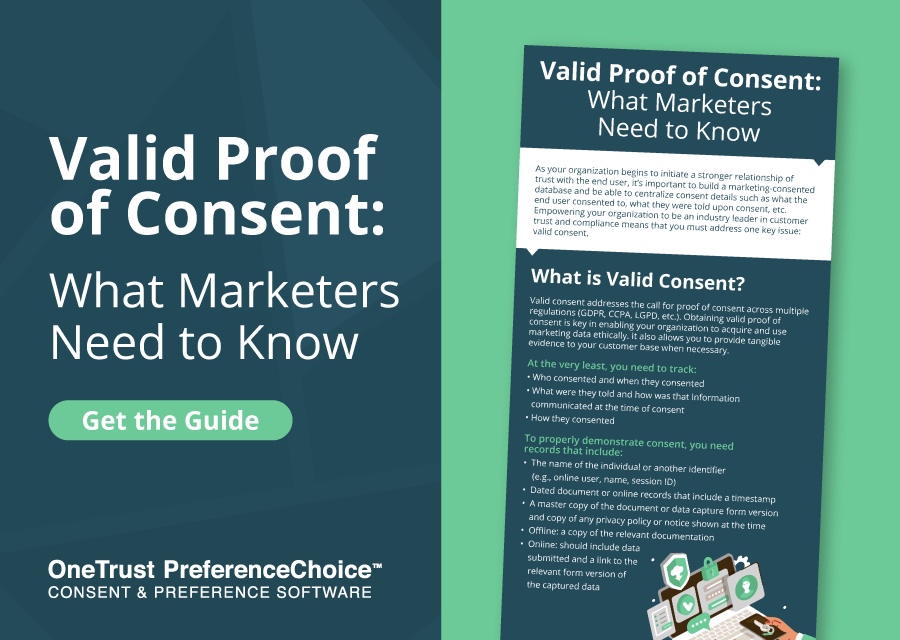
Valid proof of consent: What marketers need to know

By OneTrust

Data, trust, and compliance are three big focus areas for marketers. In terms of consent, obtaining it from your audience is critical to executing marketing activities in a privacy-centric way – and so is proving you’ve obtained that consent.

Consent matters not only for staying compliant with global privacy regulations, including the GDPR, but also for establishing a relationship of trust between your brand and your customer base. As your organization begins to initiate a stronger relationship of trust with the end user, it’s important to build a marketing-consented database and be able to centralize consent details such as what the end user consented to, what they were told upon consent, etc. Empowering your organization to be an industry leader in customer trust and compliance means that you must address one key issue: valid consent.

What is Valid Consent?

Valid consent addresses the call for proof of consent across multiple regulations (e.g. GDPR, CCPA, LGPD, etc.). Obtaining valid proof of consent is key in enabling your organization to acquire and use marketing data ethically. It also allows you to provide tangible evidence to your customer base when necessary. Many organizations today have consent stored as a simple yes or no flag with a timestamp in their CRM or marketing automation tool, which is not considered fully compliant. Multiple regulations provide guidance on keeping valid proof of consent, but you will need to at the very least track the following:

  • Who consented and when they consented
  • What they were told at the time of consent
  • How they consented

Many marketers rely on a simple checkbox and a yes/no answer for consent. However, to properly demonstrate consent, you need records that include:

  • The name of the individual or another identifier (e.g. online user, name, session ID)
  • Dated documents or online records that include a timestamp
  • A master copy of the document or data capture form Version and copy of any privacy policy or notice shown at the time
  • Offline: a copy of the relevant documentation
  • Online: should include data submitted and a link to the relevant form version of the captured data

To learn what marketing activities require consent and what regulations apply, download this free infographic from OneTrust Consent and Preferences.

Content Management

Do you specialise in Content Management? We want to hear from you!

Each month on Digital Marketing Briefing we’re shining the spotlight on different parts of the print and marketing sectors – and in January we’ll be focussing on Content Management solutions. It’s all part of our ‘Recommended’ editorial feature, designed to help marketing industry professionals find the best products and services available today. So, if you specialise in Content Management and would like to be included as part of this exciting new shop window, we’d love to hear from you – for more info, contact Clair Wyld on c.wyld@forumevents.co.uk. Jan – Content Management Feb – Lead Generation & Tracking Mar – Email Marketing April – Digital Printing May – Social Media Jun – Brand Monitoring July – Web Analytics Aug – Conversion Rate Optimisation Sept – Digital Signage Oct – Brochure Printing Nov – Creative & Design Dec – Online Strategy

Digital Marketing Solutions Summit: You key to success in 2022

You can now register for the next Digital Marketing Solutions Summit, which takes place on 11th May 2022 at the Hilton London Canary Wharf. 

Click here to book your complimentary guest pass.

Your pass includes:

  • A bespoke itinerary of pre-arranged meetings with suppliers who match your requirements and upcoming projects
  • Access to a series of seminars by industry thought-leaders
  • Networking with like-minded peers
  • Complimentary lunch and refreshments throughout

2021 Delegate Testimonials:

“A great, well-organised and tailored event. I benefitted a lot from the meetings I had, learning more about new solutions and have come away with great options that will help my company to grow” C-Probe Systems

“A very useful event which was easy to navigate through and ran very smoothly. It put me in front of some very useful vendors who offered relevant solutions to marketing for myself and my organisation. Would certainly attend again in the future and would recommend” Link CCTV Systems

“The Digital Marketing Summit is a great place to find out what tools and support is available in the digital world, especially if your business is new to digital marketing” Golden Bear Products LTD

Book your place here (booking form takes less than two minutes to complete).

23% more emails sent on Black Friday 2021

23% more emails were sent by ActiveCampaign’s 150,000 customers on Black Friday this year compared to 2020.

Key findings for analysis of it’s own data found:-

  • Friday was the biggest day for emails to be sent with 486m sent in 2021. That’s up 23% on last year’s figures of 393m
  • Brands increased their daily email sends leading up to Friday
  • Customers placed the most orders on Friday with over 290,000 orders placed on that day alone
  • Customers also abandoned more carts from last year. With abandoned carts in 2020 containing over $10 million in revenue compared with over $16 million in 2021.
  • Friday was also the day that saw the greatest abandoned cart efficacy by revenue. ActiveCampaign customers were able to recover 16% of abandoned cart revenue on Friday alone in 2021. This is up from just 7% in 2020 and 4% in 2019.

While Friday is still the biggest day of the week for ecommerce, there is a huge missed opportunity for ecommerce brands to continue the momentum on Saturday.

Friday to Saturday saw a big decrease (-85%) in email sends. Brands sent just 262,000 emails on Saturday, 85% less than they sent on Friday.

Customers left $76.4M in revenue in abandoned carts in 2021, but ActiveCampaign customers were able to recover $10.4M, 14% of that revenue. This is double the % of Abandoned Rev that was recovered 2021 v. 2020, and that’s up from just $1.2M recovered revenue in 2019.

The data is based on the email sends of 150k ActiveCampaign users and on the ecommerce integrations that their customers used during the week of Black Friday (Sunday through Saturday).

Brand loyalty being tested by supply chain issues

Cancelled orders and lengthy delays because of the supply chain crisis are testing British consumers’ brand loyalty like never before, with 85% of young shoppers saying they would rather switch labels than wait for their favourites to arrive.

The surprising findings show just how seriously the supply chain bottleneck is affecting peoples’ buying habits, with 91% of consumers in the UK worried that the problems are here to stay.

The research, carried out by Oracle, shows that 77% of respondents have felt the supply pinch, which has been blamed on the impact of Covid and post-Brexit adjustments.

Feelings of frustration and anxiety are common place with 74% of people saying that future delays could cause them to cut ties with their favourite brands permanently.

But consumers’ faith in technology to help iron out kinks in the supply chain is strong, with 70% saying they would be more willing to buy from a brand they knew used artificial intelligence to manage their supply chain.

“Businesses need to be able to provide a consistent and transparent service to customers or risk losing them, with some consumers willing to sacrifice the product quality for the ease of delivery”, said Emma Sutton, chief customer officer, EMEA Consulting, Business Transformation, Oracle. “Supply-chains are global but the technology is available to manage them from anywhere in the world, predicting disruption in order to get ahead of it, and keeping customers updated in real-time.”

34% of CMOs ‘don’t trust’ their marketing data

Over a third of Chief Marketing Officers (CMOs) don’t trust their marketing data, rising to 41% among their data analyst colleagues – posing a challenge for the C-suite charged with driving marketing results.

That’s according to research from leading marketing data analytics platform Adverity. What’s more, there is a growing divide between data analysts and marketers when it comes to trusting their data.

Yet, the very same divide deepens at the leadership level—with 51% of Chief Technology Officers (CTOs) & Chief Data Officers (CDOs) lacking trust in the data compared to 34% of CMOs.

The new “Marketing Analytics State of Play 2022: Challenges and Priorities” research commissioned by Adverity surveyed 964 marketers and data analysts across the U.S., U.K., and Germany, identifying the key strategic challenges faced by marketers and data analysts as well as their priorities for 2022.

For businesses, such a trust divide that becomes greater the more senior you go should cause significant alarm. Teams are failing to communicate mistrust, which results in key strategic decisions regarding spending, budget allocation, and campaign optimization being made without accuracy or confidence, potentially resulting in huge amounts of the marketing budget being misused or ultimately wasted.

One of the most likely causes of the distrust in marketing data and the number one challenge cited by both marketers and data analysts (42%) is the time being wasted manually wrangling data. At the C-level, this jumps to 54%.

“Modern marketing can’t afford to wait three weeks for someone to sift through a spreadsheet. By manually wrangling data, businesses not only open themselves up to human error and inefficiency but also commit themselves to a reactive strategy,” said Harriet Durnford-Smith, CMO at Adverity. “Those who cannot keep up with the evolution or aren’t willing to embrace the new ways of working will ultimately be left behind. Moving away from manually wrangling data is the first step to becoming a data-driven business.”

As marketing spend continues to recover to pre-pandemic levels and marketers are challenged to demonstrate the Return on Investment (ROI) of their campaigns, being able to demonstrate the business impact of marketing is imperative. However, 38% of data and marketing professionals state the inability to measure ROI on marketing spend is one of their biggest challenges. Combined with a lack of trust in the data, this can cause significant problems for businesses.

Looking forward to 2022, 65% of marketers and data analysts state that audience-building and targeting along with personalized content delivery is their most important strategic focus. This is unsurprising given concerns around third-party cookie deprecation and the increasing strictness of privacy laws. Content in the future is likely to have to work harder for businesses to gain access to customers’ zero and first-party data. Creating a tailored and transparent value proposition is an essential strategy for achieving this.

However, businesses need to also invest in their campaign reporting capabilities. Respondents that already have strong campaign reporting are three times more likely to be strong at audience-building and targeting and delivering personalized content/customer experiences.

Shockingly, businesses that already have strong campaign reporting are also three times more likely to invest in it than businesses that said they need to improve. Meaning that the divide between those who are garnering greater insights from their reports and those who are not is only widening.

How to bridge the sales and marketing alignment gap – once and for all

By John Cheney, CEO of cloud-based CRM vendor, Workbooks

Alignment between sales and marketing should be a priority for any business leader looking to generate growth. Of course, experience tells us it’s easier said than done. Their destination may be the same, but often sales and marketing teams have been at odds when it comes to getting there, relying on different approaches, using different success metrics and speaking different languages.

And yet, sales and marketing alignment is not new to the agenda. So why is it still so difficult to achieve? According to Gartner, less than half of organisations (49 per cent) have a common lead definition that was developed and agreed upon by sales and marketing teams together – more than one-third fewer organisations than expected. At Workbooks, we put this alignment gap down to three things:

    1. A lack of communication
    2. A lack of insight into each team’s customer interactions
    3. Disparate and disconnected technologies

The business impact of these can be very costly. Lack of coordination between sales and marketing is not only a cause of frustration for employees; according to a study by LinkedIn, it wastes an estimated $1 trillion annually in the United States alone. Even for those organisations whose sales and marketing teams appear to operate harmoniously, it’s enough to make you question: “How could we be doing more?”

It starts with you

The first step to achieving greater alignment between sales and marketing functions is to recognise the importance of doing so – and prioritise it for your business. Ensure an open dialogue between the two departments, where you can discuss the important questions: Are sales and marketing goals truly aligned? Are teams communicating as well and as often as they should? Does each function really know how the other is communicating with prospects and customers? Have you agreed common definitions – for example, what is a qualified lead (you might be surprised to hear two very different answers!)? Could teams work collaboratively – and more productively – using shared tools? Ultimately, what financial impact could a better alignment of sales and marketing functions have on the organisation?

Most businesses that probe a little deeper in this way conclude that there is room for improvement. The question then becomes: “How can we make it happen?”

Share goals, performance targets and metrics

Much of the frustration we hear from sales professionals when discussing marketing relate to two things: insufficient focus on revenue generation and unviable or unqualified leads. Marketers, on the other hand, often feel that salespeople do not show enough interest in – or acknowledgement of – long-term brand building, that they are not following up on leads provided, and not providing feedback on why leads may be qualified out.

Spend time at the outset communicating the importance of short-term revenue growth and long-term brand development, and ensure both teams are clear on what the sales and marketing process looks like. Then put in place KPIs that measure both teams on their contribution. Shared goals and KPIs should always be centred around the pipeline and revenue; this will go a long way towards bridging the alignment gap, with both teams agreed on the metrics they will be measured against.

Enable with technology

By 2025, 75% of the highest growth companies in the world will deploy a revenue operations (RevOps) model, according to Gartner; a move away from siloed and linear sales enablement functions towards revenue enablement activities that support all customer-facing roles and connect every single part of the business.

This level of alignment will take time, effort, and commitment across the organisation – it is not something that can be achieved overnight. Technology can, however, make the transition faster, simpler, and more effective. It can also help ensure these changes stick. Specifically, CRM systems can provide a single source of truth, centred around the customer. Using these systems provides access to features such as dashboards and reports where sales professionals and marketers can easily see the sales pipeline and track performance and conversions at each stage of the buyer journey, allocate tasks between departments, and make required changes to marketing and sales campaigns that are visible to all.

Crucially, a CRM system is both a result and a prerequisite of successful sales and marketing alignment; it requires everyone to have agreed a common language, set mutual KPIs, and showed a willingness to work together. But business leaders and their CRM providers must also keep in mind why sales and marketing alignment has yet to be achieved, and these reasons can differ from business to business. Look for a technology provider that wants to understand these nuances, get under the skin of your business, and agree clear business outcomes based on your objectives, to ensure maximum return.