
Digital Marketing Solutions Summit | Forum Events Digital Marketing Solutions Summit | Forum Events Digital Marketing Solutions Summit | Forum Events Digital Marketing Solutions Summit | Forum Events Digital Marketing Solutions Summit | Forum Events

All

Email Marketing

5 insights into email marketing from 2020

By Michael Trapani, Senior Director of Product Marketing, Acoustic

Benchmarking an unexpected year, like 2020, can be a significant challenge. With so many factors affecting your company’s performance, how do you go about it? Comparing your performance in 2020 to 2019 (or any other year) will hardly account for the outsized influence a global pandemic had on your business, and the market as a whole.

Our newly released email marketing benchmark report, though, showcases the influence that the pandemic has had on email marketing based on data from thousands of marketing teams.

This benchmark is an indicator for your performance through an unprecedented year and a source of insight into consumers’ responses to the pandemic, current events, and how email marketing prevailed. These metrics uncover five primary insights:

  1. Pandemic lockdowns drove a huge increase in email engagement by consumers.
  2. It wasn’t just the pandemic — other global events impacted performance of email engagement.
  3. Email has further established itself as consumers’ preferred channel of engagement.
  4. COVID-19 messaging grew tiring and drove unsubscribes.
  5. Key industries were affected in different ways as a result of the pandemic and current events.

Let’s take a closer look.

  1. Pandemic Lockdowns Caused a Spike in Engagement

In March and April of 2020, the world entered the first wave of pandemic lockdowns and most of the in-person economy paused. However, while in-person shopping came to a halt, digital soared, leading to a surge in engagement with email marketing. Email marketing open rates increased 31% from January 2020 to April 2020.

While consumers sat at home, they opened more brand emails. Constantly online, the spring of 2020 was the perfect environment for email engagement. With higher open rates, click rates rose too: from January to April 2020, click rates increased 28.6%.  

2. Email Open Rates Coincided with Current Events

The pandemic wasn’t the only event that impacted email marketing performance. Natural disasters coincided with increased email engagement in the energy and environment industry. Unfortunately, the second half of 2020 saw a historic number of hurricanes, wildfires, and droughts. The industry was a clear outlier in the second half of the year, with multiple months exceeding a 40% open rate as a result — well above other industries measured.

The political arena of 2020 also had an impact on email marketing performance. Government-related emails saw a large uptick in November, coinciding with the U.S. presidential election. Open rates continued its upward trajectory for the industry through December, too, after the election was called.

3. In the “New Normal,” Email is Preferred

Email has always been a popular channel, but in the “new normal,” consumers are favoring this channel more than prior to the pandemic. Across the board, open rates increased since the pandemic’s start. While engagement peaked while we were in lockdown in the spring of 2020, engagement rates, overall, increased during the “new normal.”

In fact, every region measured had a higher click-to-open rate in the second half of the year. Europe saw the highest click-to-open rate in H2 of 2020, with an average of 14.8%.

Globally, consumers are more likely to engage with emails. This signifies a growing affinity for email communications as well as brands getting better at targeting the right consumers with each email.

4. COVID-Messaging Grew Tiresome Quickly, Driving Unsubscribes

While engagement was up, so was the unsubscribe rate. Other than India and Asia Pacific, every region had a higher unsubscribe rate in the second half of the year compared to the first. Overall, unsubscribe rates were 34.4% higher by year’s end, globally.

This could be a result of the COVID-19 messaging sent en masse to “unclean” lists. It was common practice for CEOs and brands to send pandemic-related updates to their entire list about the state of their business, like processes installed that kept employees and customers safe. This likely alerted many customers that brands they no longer shop with nor have affinity toward had their contact information, prompting them to unsubscribe.

5. Industry Highs and Lows Throughout 2020

Not all industries were equally prepared for the rapid digital transformation that took place: some industries thrived in a lockdown environment while others suffered. Unsurprisingly, hospitals and healthcare enjoyed high engagement throughout the entirety of H2, ranging between about 30 to 35% open rates. Because consumers were anxious for COVID-19 updates, they were more likely to interact with related content.

Two industries hit especially hard by the pandemic were travel and retail. Travel, for the most part, came to a halt for much of the year and the pandemic’s impact on the retail industry has been well-documented as dozens of retail hallmarks went out of business. This performance is reflected in their email marketing, as well. Travel and retail were two industries with consistently low open rates and low CTORs compared to other industries, rarely eclipsing 15% for open rates and hovering around 10% for CTOR.  

Getting Back to Basics with Email

While 2020 saw unexpected global changes, the “new normal” demonstrates that email marketing is a reliable tool with staying power. Comparing your performance from before and after the pandemic can signify how your brand is performing in the “new normal” as well as how you stack up in your market. Overall, global open rates increased in the latter half of the year by 6.5%. If you trend under the industry average, you can implement strategies to improve your email engagement, such as more advanced targeting to understand what content your audiences interact with more.

Despite many new marketing technologies and opportunities seeming to emerge daily, email is still growing. Make sure your email marketing strategies can keep pace. 

If you’d like to review the results of the full Acoustic report, download it here.

Marketing directors ‘bullish’ about post-COVID outlook

The UK’s top 50 chief marketing officers are bullish about the growth of their organisations as the country emerges from lockdown, according to new research from the Chartered Institute of Marketing (CIM).

CIM’s latest report, ‘The CMO 50’, reveals that 71% of marketing leaders believe that the COVID-19 pandemic has had a positive impact on the perception of their brand, despite more than half (57%) having seen marketing budgets cut over the last year.

Whilst 52% believe that the marketing sector is stronger than five years ago. Only 20% believed it was weaker.

The research shows CMOs are optimistic about the post covid economy with levels of confidence rated at 81 out of 100. In comparison overall business optimism was rated at just 62 out of 100.

Marketing leaders identified four clear themes underpinning their future plans to adapt to the needs of the post-Covid economy:

  1. Adaptation to changes in technology and data;
  2. Motivating, retaining and managing people;
  3. Recruitment and development of the right skills;
  4. Demonstrating the value of marketing investment vs. expenditure.

The research also identified a desire to address regulatory issues affecting marketing. Just 26% of the CMOs believe the current regulatory regime for alcohol, gambling, HFSS (high fat, salt and sugar) products and environmentally damaging goods is fit for purpose, and the majority would back rules equivalent to those for cigarettes to restrict the marketing of potentially harmful goods and services.

  • 76% back marketing restrictions for products that damage the environment, keen to see limits similar to those for cigarettes.
  • 72% back restrictions for gambling, 58% for products aimed at children, 54% for unhealthy HFSS foods and 34% for alcohol.
  • More than half (54%) of marketing leaders think there is currently too little regulation of social media, and just 44% feel it is not the responsibility of marketers to protect the users of their social media channels. 

Chris Daly (pictured), chief executive of the Chartered Institute of Marketing said: “Marketing leaders calling for restrictions on marketing may seem counterintuitive, but it reflects a clear shift in our society towards purpose driven marketing. Marketers have been at the forefront of helping the nation adapt to the strictures of lockdown, and in doing so have built stronger relationships with consumers. That hard-won reputational boost has the potential to accelerate economic growth as we emerge from lockdown, and professional marketers are rightly wary of loose regulatory controls allowing a few bad apples to sour the trust of consumers.”

The acceleration of structural shifts in society’s use of technology is reflected in the views of marketers. 92% of those interviewed, believed that brands had a direct duty to pull advertising from social media platforms that failed to protect users. Just 44% felt that the protection of social media users lay outside the responsibility of marketers. In contrast, 86% agreed that professional marketers should encourage social media platforms to do more to protect users.

Daly added: “To prosper, a professional marketer needs clear parameters within which to work. Give them the rules and a level playing field and marketers will adapt and deliver. Having accommodated the necessary changes of GDPR, the UK’s most senior marketers are right to be wary of the dangers that poorly policed social media platforms pose to the long-term growth of their brands and the wider economy. The UK marketing community has an opportunity to build back better by targeting spend and training on marketing channels and products that deliver greater value to our society.”

Digital Customer Engagement Summit: Find your keys to success this October

This October’s Digital Customer Engagement Summit Summit is still going ahead as planned and we cannot wait to see you in person!

The Summit has been unaffected by the recent government announcements, but we wanted to update you about the guidelines that we have put in place at the event; 

– Plenty of space as the venue be running at 50% capacity

– Registration will be staggered ensuring no long queues
– Your temperature will be taken at arrival

– Face masks must be worn at all times, unless exempt or seated

– The event will be as paper free as possible – your itinerary will be sent to you via email

– Sanitation stations will be dotted around the venue for you to use

– Meeting booths will be spaced out (in line with the current social distance measures) and will consist of a table and two chairs with a protective screen

– There will be a one way system in place, which will be pointed out with arrows on the floor

– All meals and refreshment will follow the government guidelines –  creating a relaxed and fun atmosphere.
Please note, we have Flexible attendance options – for duration and also the ability to switch to VIRTUAL attendance at any given time.

We look forward to seeing you on the 13th October at Hilton London Canary Wharf.

Click here to register.

Or if you have any questions then you can contact Haley Stratton at h.stratton@forumevents.co.uk.

Digital Customer Engagement Summit: Register today!

As a professional within the customer engagement sector, we’d like to invite you to a small niche event that we’re hosting on the 13th October at Hilton London Canary Wharf.

We understand that your time is precious and extremely limited – the Digital Customer Engagement Summit can save you time by allowing you to connect and network with a range of suppliers that offer innovative and budget-saving solutions for your current workload.

Your invitation is entirely free and includes lunch and refreshments throughout. Plus, access to a series of industry seminar sessions – (Virtual attendance options are available also).

You can confirm your free place to the Digital Customer Engagement Summit HERE – or if you would like more information then you can contact us by email here.

IAB welcomes ‘opportunities’ from third-party cookie phase-out

The IAB has welcomed Google’s reaction to the Competition and Markets Authority’s (CMA) investigation into internet giant’s Privacy Sandbox initiative, asserting that it creates an opportunity to ‘reset’ the ad-funded web.

Back in January, the CMA launched an investigation into Google’s Privacy Sandbox in response to concerns that Google’s plans for the removal of third-party cookies from Chrome and its introduction of alternatives could impede competition in digital advertising markets.

At the time, Google welcomed the development and has described it as an “opportunity to engage with a regulator with the mandate to promote competition for the benefit of consumers”. 

Google has now announced a range of binding commitments to address the CMA’s concerns. These include: 

  • That it will work with the CMA to resolve concerns and develop agreed parameters for the testing of new proposals. Google will also provide transparency around the timetable, as well as a clear notice period for changes.
  • Once third-party cookies are phased out, Google’s ad products will not access synced Chrome browsing histories (or data from other user-facing Google products) in order to track users to target or measure ads on third party web inventory.
  • As the Privacy Sandbox proposals are developed and implemented, that work will not give preferential treatment or advantage to Google’s advertising products or to Google’s own sites

You can read the full list of commitments here. The CMA has now launched a consultation on whether to accept Google’s commitments, which you can respond to by submitting written representations to Angela Nissyrios and Simon Deeble at 50972-Consultation@cma.gov.uk by 8 July 2021 at 5pm.

IAB UK’s CEO Jon Mew said: “At the IAB, we have always been really clear that the phasing out of third-party cookies is an opportunity to reset the ad-funded web for the better, which is why we have laid out clear principles that we believe any viable User ID solutions must meet. I think that the CMA’s investigation into Privacy Sandbox and Google’s commitments to address its concerns about the potential impact on competition are an important and valuable part of this process. 

“The commitments  allow the wider industry to have confidence that Google’s proposals are being developed in a way that takes into account both competition and privacy objectives, with the benefit of regulatory oversight brought by the CMA. The phasing out of third-party cookies is the most seismic shift that the digital ad industry has ever experienced and it’s only right that developments in this space are subject to appropriate scrutiny.”

Three Psychological Pitfalls Marketers Should Avoid In 2021

By Norman Guadagno, CMO, Acoustic

A year in quarantine has changed consumer psychology and the rules of engagement for marketers. From dealing with isolation to significant economic uncertainty,  it is no surprise that depression has doubled for UK adults throughout the last twelve months. 

As the UK lockdown starts to ease, people are grappling with the conflicting emotions of desiring connection with each other on the one hand, yet remaining wary of too much close contact, too soon. 

For marketers, this means both adapting their 2021 plans to today’s “new normal,” contactless world, while ensuring that empathy and connection remain at the core of every communication. To accomplish this, we must all avoid the following pitfalls. 

Don’t mistake empathy for disingenuity 

We’ve all heard the same phrases a dizzying number of times by now: “These are unprecedented times,” “Stay at home, save lives,” and “We hope you’re doing well in these trying times.” For many brands, these empathetic phrases served as a pseudo-obligatory acknowledgement of current events before diving into sales-driven messaging. But for consumers, these messages quickly became white noise, a reason to ignore the communication altogether.

Data from Acoustic’s analysis of email marketing from January to May 2020 reinforces this. While open rates in the UK and Ireland increased by 19% in March versus January as consumers scoured for information on how to safely buy essential supplies and support their favourite businesses, click-through rates and click-to-open rates, on the other hand, remained relatively flat. This signals that emails with “An important message from our CEO” piqued curiosity but did not incite action or engagement. 

For marketers, the takeaway is clear: Show, don’t tell. Find creative ways to make it clear you genuinely care about your customers, without falling back on the same tired phrases. As marketers, we should emulate rigour. Our messaging should be clear, transparent, and to-the-point. The rest is just white noise. 

Stay connected with your audience 

Regardless of whether you’re a B2B or B2C brand, it’s important to remember marketing should not be a one-way street. The best marketers foster community and connection, which are vitally important in today’s context. For many consumers who are working from home, the marketing communications they receive may be some of the only forms of communication they have with the outside world in a given day, besides work and the news of the day. This gives marketers a golden opportunity to search for ways to spark conversations with and amongst their target audiences. 

After all, the pandemic has all but eliminated the small talk and water-cooler conversations that play a key role in keeping us happy and productive at work. In today’s stay-at-home world, many of us have replaced these innocuous conversations with scrolling through social media or “forced fun” like workplace happy hours on Zoom. We have less opportunity to opt-in to small talk, but brands can change that. Marketers should embrace new ways they can foster conversation and community through social media, message boards, or other means to create a sense of normality for their consumers. 

Don’t get too close 

It’s one thing to leverage consumer sentiment and personal data to make your communication more personal and relevant. It’s another thing altogether to get too granular that you prompt concern about misuse of that data and abuse an individual’s sense of trust. 

It’s a bit like dating in today’s online world, where finding out about someone is seemingly so easy. It’s almost second nature to Google your date or look them up on Facebook or Instagram to find out more about them beforehand. But would you ask them about their holiday to Croatia the year before last that you found out about? Of course not. At least, I hope not….

Marketers face a similar conundrum. We may have psychographic data about our consumers, but should we use it? And if so, how? Marketers should devise new approaches that allow consumers to be more involved in granting permission to use their data on their terms. Allowing them to actively curate information about their likes and dislikes, in exchange for a better value proposition — a better brand experience — a “give to get.” In this scenario, an informed consumer is acknowledging that a brand may want to learn more about them — and then taking things a step further by cultivating information about themselves that is relevant for brand marketers to know. In the coming months, marketers should think about how to tailor this approach to psychographic profiling to keep their communications empathetic and connected to a consumer’s personal identity. 

Ultimately, marketing and dating can be surprisingly similar. Marketers always want to keep consumers engaged and keep them coming back for more, which requires a delicate balance of reaching out to the target audience without overreaching. As marketers plan upcoming campaigns, we must avoid the artificial genuineness, one-way communication, and overt psychographic profiling that can be so off-putting to consumers. If not, those consumers just might say, “This date is over,” stand up, and leave. 

Norman Guadagno is CMO at Acoustic, an open, independent marketing cloud.

Do you specialise in Web Analytics? We want to hear from you!

Each month on Digital Marketing Briefing we’re shining the spotlight on different parts of the print and marketing sectors – and in July we’ll be focussing on Web Analytics solutions.

It’s all part of our ‘Recommended’ editorial feature, designed to help marketing industry professionals find the best products and services available today.

So, if you specialise in Web Analytics solutions and would like to be included as part of this exciting new shop window, we’d love to hear from you – for more info, contact Clair Wyld on c.wyld@forumevents.co.uk.

Here are the areas we’ll be covering, month by month:

Jul -Web Analytics
Aug -Conversion Rate Optimisation
Sep -Digital Signage
Oct -Brochure Printing
Nov – Creative & Design
Dec – Online Strategy

Print & Digital Innovations Summit: registration open!

You can now register for you free delegate place at November’s Print & Digital Innovations Summit – Secure your place today!

This is an invitation to attend as our guest on the 18th November at the Hilton London Canary Wharf.

This is a unique event designed for senior professionals like you.

Confirm your complimentary place and enjoy benefits such as;

  • Meet with budget-saving suppliers who match your requirements and upcoming projects
  • No hard sell and no time wasted – pre-scheduled 1-2-1 meetings are based on relevant interest
  • Attend insightful and educational seminars on future trends within the sector
  • Network with other senior print & marketing professionals
  • Complimentary lunch and refreshments throughout

Click here to secure your place, or contact me today for more information.

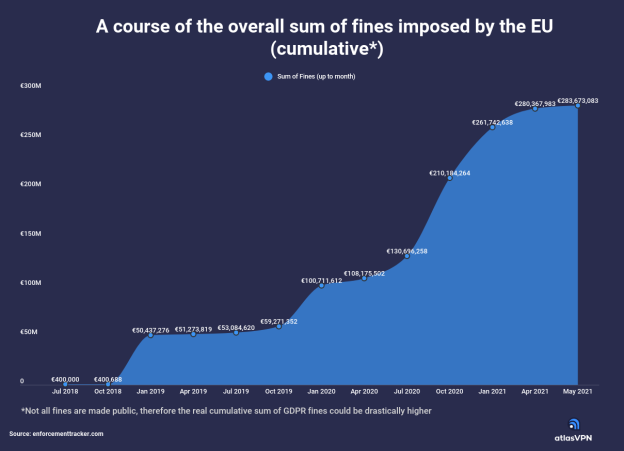
GDPR fines hit nearly 300m euros in three years

The General Data Protection Regulation (GDPR) was implemented in the EU three years ago on May 25th. This legislation aimed to give the residents of the EU more control over their data and privacy.

According to the recent Atlas VPN team findings, the cumulative sum of the GDPR fines imposed on the EU countries over the past three years has reached €283,673,083 due to a total of 648 penalties against organizations violating the data protection law.

The biggest GDPR fine so far was issued in January 2019. The French regulator CNIL fined Google €50 million for failing to provide transparent information on its consent policies and the way it handles ad personalization.

After that, another massive increase in penalties happened between October 2019 and January 2020. Thus, since the start of GDPR, organizations have been fined a total of €100,711,612 due to 167 violations.

In 2020, from July to October, there was a significant increase in the sum of fines. It was because 3 out of 5 most enormous penalties of all time were issued in October.

Cybersecurity writer and researcher at Atlas VPN William Sword, said: “GDPR has empowered EU citizens to be more actively involved in what is happening with their data and understand their privacy rights. As for organizations, complying with data protection rules will create a more trustworthy environment between them and consumers. ”

GDPR violations in specific countries

Privacy regulators in each country were closely monitoring companies to make sure that people’s data is dealt with responsibly.

Italy has assessed the most significant sum of fines over three years — €76,271,601. So far, Italy has been penalized a total of 77 times.

France takes second place with €54,661,300 in fines. The largest part of the amount was made off of the previously mentioned Google fine.

In third place sits Germany, where GDPR violations have cost companies €49,186,833.

Even though Spain has slightly less in the total sum of fines — €29,521,410, they have had the most violations. More than one-third of all GDPR penalties (230) were imposed upon Spain.

A people-first celebration – Register for ON Festival today!

ON Festival by Freshworks will host an exciting line-up of speakers who have pioneered the values that put people first in business. Coupled together with world-class entertainment, this event will leave you feeling energised, inspired and entertained.

Together with over 5,000 business leaders from across Europe, ON Festival will explore the role you and your organisation will play in embracing values such as happiness, empathy, well-being and the impact your organisation has in the local community. These values are now essential for building long-lasting customer and employee relationships.

Broadcasted live from London, Paris, Berlin and Amsterdam, this is your chance to switch ON positive values that put people first.

Join ON Festival online on June 24th, 2021 from 2 PM BST / 3 PM CET.

Over 3 hours starting at 2pm BST, we have an amazing lineup of speakers:-

· Girish Mathrubootham – CEO of Freshworks
· Tal Ben-Shahar – Top course of all times- Harvard University
· Marc Randolph – Co-Founder of Netflix
· Alex Dimiziani – Former Head of Global Comms AirBnB

Click Here To Register