Digital Marketing Solutions Summit | Forum Events Digital Marketing Solutions Summit | Forum Events Digital Marketing Solutions Summit | Forum Events Digital Marketing Solutions Summit | Forum Events Digital Marketing Solutions Summit | Forum Events

All

Looking for new Digital Signage solutions? Start right here…

Sourcing new suppliers, solutions and innovations is time-consuming and, frankly, dull. Hours of Googling, arranging meetings and travel… but there is another way.

The Digital Signage & Interactive Solutions Summit is our answer.

23 & 24 September – Radisson Blu Hotel, London Stansted

This two-day event will give you the opportunity to meet with innovative and budget-saving suppliers, face-to-face, based on your own individual requirements.

No time wasted. And no hard sell.

It’s free for you to attend, plus overnight accommodation, all meals and refreshments plus an invitation to our networking dinner are included.

But you should register now to avoid disappointment as we have a limited number of free VIP places.

The suppliers attending will cover the full range of HR solutions, and include:

Beaver Group
John Anthony Signs
LG
Linney
MRG Systems
SIS Digital
Sony Europe
Volume Networking

This is two days of ‘speed dating’ for business, and you’ll also have the opportunity to attend inspirational seminar sessions and network with like-minded professionals throughout the event.

Places are limited, so register today!

Brands urged to embrace the ‘purple pound’

Businesses are being encouraged to register for Purple Tuesday to learn more about the purple pound – the spending power of disabled people and their families.

Over 13 million people in the UK, one fifth of the population, live with a disability and households with a disabled person spend a combined £249 billion a year.

But many businesses could do more to provide for disabled customers, according to the organisers of Purple Tuesday.

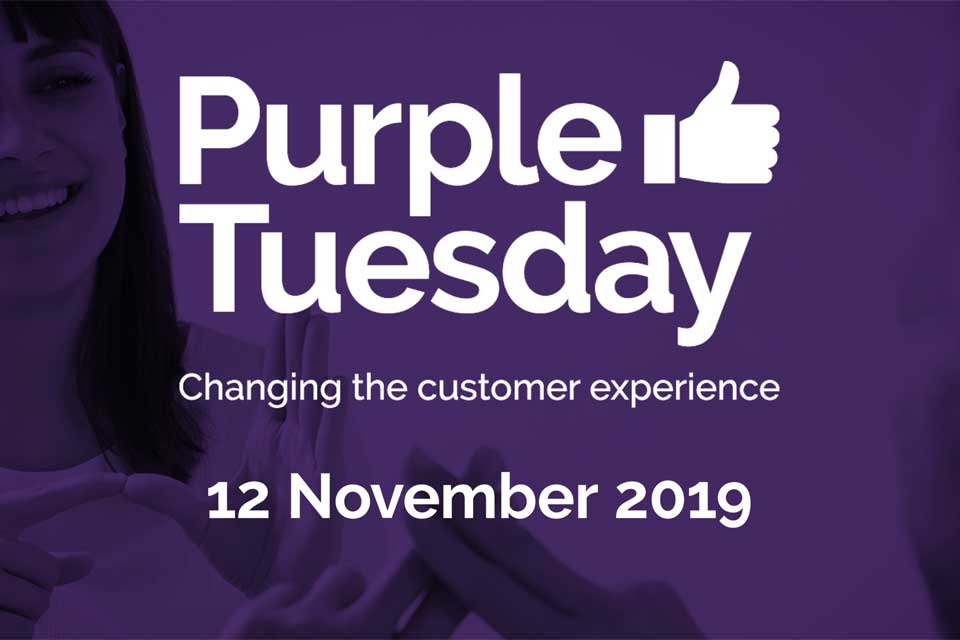
Purple Tuesday is an international call to action which will take which place on 12th November 2019. Created and coordinated by disability organisation Purple, it celebrates the power of the purple pound and asks businesses to make a commitment to improve their offer to disabled people. Businesses that register for Purple Tuesday will benefit from free resources from Purple on topics such as website accessibility and customer service training.

Last year over 750 organisations participated, including retail giants Asda, M&S and Sainsbury’s. This year, Purple Tuesday will engage with organisations across multiple sectors on an international level.

Geraldine El Masrour, Centre Manager of Motherwell Shopping Centre, worked with Purple to prepare the centre for Purple Tuesday and saw first-hand the impact of the day on her staff and customers: “Following Purple Tuesday, one of our Security Officers put his dementia training into action to support a shopper, who had previously been seen as disruptive, to make a purchase. The customer was so happy he cried.” Geraldine has since been nominated as Centre Manager of the Year for the SCEPTRE Awards, she says: “I’m sure that working with Purple and taking part in Purple Tuesday has helped me to be shortlisted and I’m looking forward to making continued improvements to our services for disabled people as we build up to Purple Tuesday 2019.”

Mike Adams OBE, Chief Executive of Purple Tuesday said: “Meeting the needs of disabled customers makes commercial sense for businesses of all sizes, from all sectors.

“Purple Tuesday is a milestone moment, but the issue is relevant 365 days a year. From retail to restaurants, tourism to insurance, we’re calling on businesses across all sectors to back Purple Tuesday and commit to changing the customer experience for disabled people for good.”

Minister for Disabled People Justin Tomlinson said: “A day out for disabled customers should be an enjoyable experience to share with family and friends, but for so many it can be such a hassle that they end up staying at home instead.

“That is a terrible shame, not only for the UK’s 13 million disabled people but for Britain’s businesses who are missing out on the huge spending power of these valuable customers. It’s also not acceptable in this day and age.

“I want businesses across the country to get involved with this year’s Purple Tuesday and open their doors to disabled customers – not just on this day but all year round.”

Disabled people tend to be more brand loyal than the average consumer, yet less than 10 per cent of businesses worldwide currently include disabled customers in their marketing plans. By failing to meet the needs of disabled people, businesses could be missing out on a share of £2 billion a month.

As well as providing free resources for Purple Tuesday participants, Purple provides tailored accessibility consulting and support to businesses through paid Purple Memberships and Partnerships.

Purple Members receive benefits including website accessibility diagnosis with recommendations which are free of low cost to implement, as well as consultancy with Purple and support through the Government accredited Disability Confident programme.

A Purple Partnership is designed for organisations with experience of disability issues who want to benefit from longer-term consultancy to address employee, consumer and supply chain related issues. Both Members and Partners receive discounts on Purple’s additional training and auditing services.

To register for Purple Tuesday and join organisations across the globe in changing the customer experience for disabled people, visit https://purpletuesday.org.uk/.

Retailers urged to embrace digital personalisation

Retails have been urged to extend personalisation at every digital touchpoint and to every individual using AI, in light of more dire warnings on the state of the High Street.

The British Retail Consortium and KPMG have noted the lowest sales figures since 1995 in May, which in a year plagued with closures and CVAs raises the alarm for further decline in the UK high street in the coming months.

According to Raj Badarinath, VP Ecosystems at RichRelevance, brands and retailers are desperately looking for a solution, but stubbornly ignoring the most critical factor: what customers want.

Badarinath asserts that instead of exploring their customers as individuals (not rough marketing-made segments) they keep holding on to outdated personalisation tactics that are clearly not good enough.

“It is disappointing to see retail sales falling year on year in the UK. It’s a tricky time for UK retailers – as they battle on multiple fronts: monopolies like Amazon, ankle biters such as DVNBs (Digitally Native Vertical Brands) and more,” said Badarinath.

“UK consumers today are short on time and inundated with the problem of choice – too much content, product, offers and more. Retailers should reduce decision fatigue by extending personalization at every digital touchpoint and to every individual using AI, which provides the technical ability to do so for the first time. Retailers realize that the UK consumer is fickle and easily wooed, so techniques like hyper-personalization ensure a seamless, memorable customer experience, to increase repeat sales and improve overall lifetime value.”

UK ad spend to hit £21.8 billion in 2019, but growth slows

Advertising is on the up, with UK spend expected to increase to £21.8 billion, up from £20.5 billion in 2018.

That’s according to the latest forecasts by media investment group, GroupM, which predict 6.1 percent growth for 2019, down from 7.8 percent in 2018, with this year aided by decent underlying growth, admittedly with a slight decline.

Brexit still occupies management bandwidth, which in turn affects ad-budget setting with the potential to lead to reductions.

Digital advertising continues to grow at around 11 percent for 2019, accounting for more than 60 percent of total UK advertising, of which over half is search.

Digital media ‘pure plays’ represent the largest group of ad sellers, with Facebook and Google accounting for around three-quarters of the figure on a gross basis.

After hitting £4.5billion, television accounts for around 20 percent of media investment and remains a stable medium in terms of advertising, with spending left unchanged in 2018 over 2017, with levels set to remain for a 24 month period.

Radio also appears set to hold on to its revenue base this year, followed by closer to +2 percent growth next year, along with Out-of-Home (OOH), digital formats which are becoming increasingly important, accounting for half of spending in OOH during 2018, with further share gains still to come especially as more automation takes root, including the emergence of performance-based targeting and data-driven trading. For now, GroupM forecasts growth exceeding +3 percent in each of 2019 and 2020.

The losers in the advertising game continue to be print, with newspapers and magazines now accounting for less than 10 percent of media investment combined in 2019, down from more than 50 percent in a 15-year period.

Image by Falkenpost from Pixabay

Add your name to our VIP guest list today!

Don’t miss the chance to join fellow print and marketing professionals this summer at the Print & Digital Innovations Summit – takes place on November 14th at the Hilton London Canary Wharf.

In addition to a full day of business networking, you will get the latest insights and advice on trends in the sector via a series of seminar sessions.

Lunch and refreshments are included with your free ticket.

Register today and join fellow professionals from:

ARYZTA Food Solutions
Avon Cosmetics
Bankable
Direct Line Group
Envision Pharma Group
Keystone Law
M&G Investments
NSAR
Premier Holidays
Programmemaster
Royal Mail
The Hamleys Group
The Landmark London

Don’t miss out on this unique opportunity! Register your free place today.

Digital Customer Engagement Summit – Claim your free ticket!

There’s a free VIP place reserved for you at this autumn’s Digital Customer Engagement Summit on October 15th.

This unique event takes place at the Hilton Canary Wharf, London.

Can you confirm you will be joining us?

The Summit will give you access to innovative and money-saving suppliers for a series of pre-arranged, face-to-face meetings based on your requirements.

You can also attend a series of seminars, and network with like-minded peers.

Lunch and refreshments are included with your free VIP ticket.

If this would be useful for your business, please confirm your attendance here.

Places are limited, so register today to avoid disappointment.

SME GDPR compliance only ‘skin-deep’

72% of UK SMEs report being ‘very aware’ of GDPR and its requirements, but 60% say that the recent changes to data protection have had a ‘slight’ or ‘no’ impact on their business, while 8% do not know.

The figures, from a survey commissioned by Shred-it, have revealed a positive understanding and engagement with the principles of GDPR among SMEs on its first anniversary, but also highlight a possible cosmetic understanding and key areas of concern around the more complex aspects of full compliance.

The independent survey of 1439 SMEs comprised a series of unprompted questions and covered a range of businesses in specific market sectors across the United Kingdom with 85% having 10 to 49 employees.

When asked about GDPR readiness nine in ten rated themselves as a ‘4’ or ‘5’ out of 5; the main actions taken were reviewing policies (45%) and emailing customers for consent (35%). These are considered to be the lighter ‘front end’ aspects of GDPR compliance according to Shred-it’s experts.

The survey data showed that one third (32%) of SMEs reported that GDPR has had a ‘great’ or ‘considerable’ impact on their business. When those businesses that had experienced challenges with GDPR compliance were probed further, they cited data breaches and disclosure requirements as the main challenges, with healthcare (27%) and real estate (25%) the main industries affected with those specific areas. Small proportions also reported issues with subject access requests, again with healthcare (28%) and real estate (15%) being the main industries affected.

Ian Osborne, Vice President UK & Ireland for Shred-it, said: “On the surface it is good news. It is clear that many feel they are already compliant with GDPR having reviewed areas such as ‘consent’ activities and publishing a privacy notice. These typically deal with the ‘front end’ aspects of GDPR. However, while many say they are ready, there is a real question mark over the extent to which the majority of SMEs are prepared to respond to a data breach or how to react to a subject access request, for example. Our survey suggests that there is still a need for a large education exercise to show SMEs what is really involved in GDPR compliance at depth.”

Of the 10% that said they were ‘not quite’ or ‘not at all’ ready, who rated themselves as a ‘1’ to ‘3’ out of 5, 42% (54 businesses) said they have not been dealing with it; when asked what was holding them back, their unprompted reasons were that data protection authorities were ‘only interested in bigger companies’, it was ‘not applicable to us’, it was ‘too complicated’, and they were ‘too busy’. Of the 10%, two in five would only trust someone in-house to help them comply with GDPR – only one in ten would consider external support and only 4% would trust the data protection authority for assistance. The SMEs that would consider external support were unsure what services they needed and when they would intend to look for support.

In the twelve months between 25th May 2018 and 2019 the Information Commissioner’s Office (ICO), the UK’s independent authority set up to uphold information rights in the public interest, has taken 59 enforcement actions.

Osborne added: “Our survey seems to show two clear pictures emerging. One is where the majority of SMEs are genuinely engaged with the process of compliance; within that group there are many who believe they are already compliant but may have missed some key more complex parts of the GDPR. It is the minority in that group who have recognised its greater challenges and are wrestling with its more complex areas. The other is one where some SMEs recognise they are not ready, seem unwilling to address the issue of GDPR compliance and are reluctant to seek support in any form to help them. When the relevant authority’s fines become more common headlines across the UK, we expect that views may change about what compliance really means.”

Retailers ‘neglecting Twitter and Facebook for customer service’

Retailers are neglecting social media when it comes to customer service, and are not listening to consumers to drive customer experience improvements.

That’s according to the 2019 Eptica Digital Trust Study, which found that while retailers successfully answered 59% of routine queries asked via web self service, chat, email, Facebook and Twitter, there were wide variations in performance between channels.

Retailers provided answers to 83% of queries on their websites but only responded correctly to 38% of tweets and 50% of Facebook messages. Performance had worsened on many channels since 2017 – then retailers answered 73% of emails.

By 2019 this had dropped to 68%, despite the continued popularity of the channel with consumers, who use it for over a quarter of their interactions with brands.

As part of the study, 20 fashion and food & drink retailers were evaluated on their digital customer experience, alongside brands from other sectors, by testing their accuracy and speed at answering relevant, routine queries, repeating research conducted since 2012. Questions included asking about ethical sourcing policies (fashion) and allergy labelling (food and drink).

Additionally, 1,000 consumers were asked for their views on customer experience.

Fashion (answering 60% of all queries) and food and drink (59%) were the top sectors surveyed but still failed to respond to 4 in 10 of all routine queries.

The research also demonstrated a direct link between trust, listening and loyalty. 89% of consumers surveyed said they either will stop buying from brands that they don’t trust or will spend less. Building trust begins with delivering on basic promises – 59% ranked giving satisfactory, consistent answers as a top three factor in creating trustworthiness, while 63% rated making processes easy and seamless as key. Just 8% of consumers felt that brands were listening to them all of the time, with 74% believing brands pay attention to their views half the time or less.

“The move to digital has transformed the retail landscape,” said Olivier Njamfa, CEO and Co-Founder, Eptica. “Greater choice means consumers are becoming more demanding and are actively seeking out brands that they can trust and who listen to them. While retail brands have made some improvements since 2017, they have slipped back in others, damaging trust and ultimately customer loyalty and revenues. If they want to succeed they need to listen to customers and use their insight. Only those who do this will thrive and stay ahead of the competition.”

Retail Accuracy 2019
versus 2017
Average speed 2019
versus 2017
Web 83% vs 70% n/a
Email 68% vs 73% 10hr 19m vs 24hr 12m
Facebook 50% vs 28% 43m 24s vs 3hr 34m
Twitter 38% vs 50% 1hr 56m vs 1hr 43m
Chat 35% vs 25% 8m 43s 4m 24s
Total 59% vs 55%

Speed of response also varied widely between channels – and even within sectors and brands. One fashion retailer answered a tweet in 17 minutes, yet another took 50 hours to reply. A food and drink retailer responded on Facebook within one minute but needed nearly 23 hours to provide an answer on email. Overall response times on chat doubled from 4 minutes back in 2017 to 8 minutes this year. Facebook had the fastest average speed of response, at 43 minutes, 24 seconds – over twice as fast as Twitter (1 hour 56 minutes) and nearly 15 times faster than email (10 hours 19 minutes). This is despite exactly the same questions being asked across these channels.

The study evaluated 50 UK brands, split equally between the fashion, food and drink, travel, insurance and banking sectors. Brands were rated on their ability to answer five routine questions via their websites, as well as their speed, accuracy and consistency when responding to email, Twitter, Facebook and chat. Additionally, 1,000 UK consumers were surveyed on their attitude to trust, its relationship with customer experience and on loyalty and brand reputation. All research was completed in H1 2019.

A full report, including the study results, graphics and best practice recommendations for brands to transform customer experience is available at https://www.eptica.com/19cxretail.

An infographic on the results is available at https://www.eptica.com/state-uk-retail-customer-experience-infographic-2019.

5 reasons to attend the Print & Digital Innovations Summit

Register today for the Print & Digital Innovations Summit–  It’s FREE for you to attend and could help you reduce your expenditure.

As a VIP guest, you’ll be joining just 60 other senior professionals who are attending the event to network, learn and forge new business relationships. They include representatives from the likes of Avon, Envision Pharma Group, Programme Master, The Hamleys Group and more.

If that’s not incentive enough for you to register here are 4 more reasons…

• As one of our VIP guests, you will be provided with a bespoke itinerary of face-to-face meetings with suppliers based on mutual agreement. No hard sell, and no time wasted.
• You’ll have the opportunity to attend insightful seminars and interactive workshops.
• Network with 60 other senior professionals who share your challenges.
• Enjoy complimentary lunch and refreshments.

Taking place on November 14th at the Hilton Canary Wharf, London, the Print & Digital Innnovations Summit provides a platform for new business connections.

To find out more, visit https://printinnovationssummit.co.uk.

Is your brand’s content is working as hard as it can?

By Carrie Webb, Head of Content, The Bigger Boat

It’s no secret that a brand’s content is hugely important. It can mean the difference between and organisation being discovered online or not.

But so much more than that, quality content elevates brand perception, nurtures lasting relationships with an audience and enables companies to build authority and credibility.

In such a content-rich environment, it can be difficult to know how to grab consumers’ attention, drive real engagement, create conversations and ultimately increase conversions. Whether it’s via a well-designed infographic, a collection of helpful blog posts or a fully-fledged PR campaign, here’s how to give great content the best chance of surviving and reverberating in such a crowded place.

Build out a strategic approach

Don’t create content simply for the sake of posting something. There should be a sound detailed strategy behind it that takes into account many factors, but most importantly aims to create a connection between brands and consumers.

The first step is to identify the brand’s strengths and consider this alongside a competitor’s offering. Take a holistic view of how those in the same space behave, and look at the types of content they’re producing – what’s working and what isn’t and, crucially, how audiences are responding.

A structured, analytical approach is required to then apply learnings to the content strategy. This will provide internal guidelines and is the brand’s ‘why’ and ‘how’.

Begin by defining audience personas (include their needs, where they consume content and any challenges and pain points), the organisation’s story and messaging and nail down content purpose.

There should also be considerations for business-wide and content KPIs. Detail success metrics for every piece of content – traffic, views, shares, conversion rate, brand awareness, for example – and jot down outreach plans for them. Collating and assessing all this information leaves an overarching strategy that plans ahead for every aspect of the organisation’s marketing activity in an effort to produce the best results.

Consider shareability from the outset

Creating a fantastic piece of content that ticks all the boxes – for example, it’s user friendly, relevant, and has SEO coursing through its veins – is great, but it’s not enough to simply upload and sit back in the hope results will flood in.

If a business isn’t promoting its own content, it’s missing out on many outreach possibilities. There’s no harm in giving customers a helping hand in finding content. If there’s budget, look towards PR, consider paid promotion or use influencers to shout about the work.

Email marketing provides a good way to round-up and tease content on the brand’s site and, of course, sharing contentacross the relevant social platforms is always a winning tactic when looking to start conversation.

Finally, don’t underestimate the value of employee advocacy. If a workforce shares its content, this shows customers that staff members have bought into the brand – and its content is credible. It also ensures a much higher reach without having to put extra budget behind it.

Write for the desired audience

A business should know its audience better than they know themselves, and create content that perfectly tailors to their needs and behaviour. This is key to content success.

Provide answers to questions asked, offer a viewpoint on topics customers are interested in, and ensure the brand is operating in a space where the target market is digitally active.

Genuinely useful, purposeful content gains more traction and is more likely to resonate in a meaningful way. Knowing – and serving – an audience is vital in content marketing. After all, the goal isn’t always to simply clinch a sale – there needs to be an effort to work hard and gain their trust, and convert them into advocates. Consistent, quality content that provides for their needs should do just that.

Ensure CTAs are simple and structured

Find subtle ways to encourage an audience to share thoughts, move through to another piece of relevant content or perform a customer action. Whether it’s to download a PDF, buy a product or simply head on to another blog within the site, the call to action (CTA) should be well-designed and strategically placed, with clear and compelling text.

Use the right words to give the CTA an obvious thrust – the user must be left in no doubt as to what’s being asked of them, and what they’ll receive if they click.

Make it timeless

The best content is evergreen – it doesn’t have an expiry date. Its information is as useful and relevant now as it will be five years down the line.

‘How to’ guides are a great example of content that doesn’t date. While there will always be a place for seasonal, topical content, it won’t have much appeal once conversation around it has subsided and an organisation is left with an initial increase in traffic that will quickly fade.

During its 20th anniversary celebrations in September 2018, Google announced a selection of new search features. Among them was the ‘Topic’ layer in the search, which aims to recommend new content to the user after analysing the web for a topic and developing a huge range of subtopics. It favours the most relevant content, namely that which has shown itself to be ‘evergreen and continually useful, as well as [being] fresh content on the topic’.

Harness the power of analytics

Insights software provides invaluable data as to how content is performing and can help to make strategic decisions.

For each piece of content created, its objectives and goals should have been set out in the content strategy at the very beginning of the process – using analytics gives specifics of whether it’s meeting them. Find out what’s working and what’s not by measuring traffic, bounce rate, dwell time and engagement, for example.

If content isn’t doing too well, an organisation will gain insight into why that is, and should make changes accordingly to avoid making the same mistake with future content.

Using an analytics tool should be routine for content marketers – do it correctly and learn what makes users tick, where they’re coming from, what type of content they favour and easily pinpoint successes, and where improvements are needed.

Apply detailed consideration to the strategy behind content as well as its aftercare and ensure it works as hard as it can for the brand.

With time, effort and consistency in the approach, content will find its place with the right audience, help raise brand perception and generate the desired results.

Carrie Webb is head of content for The Bigger Boat – a creative digital marketing specialist business based in Yorkshire.