Digital Marketing Solutions Summit | Forum Events Digital Marketing Solutions Summit | Forum Events Digital Marketing Solutions Summit | Forum Events Digital Marketing Solutions Summit | Forum Events Digital Marketing Solutions Summit | Forum Events

Posts By :

Stuart O'Brien

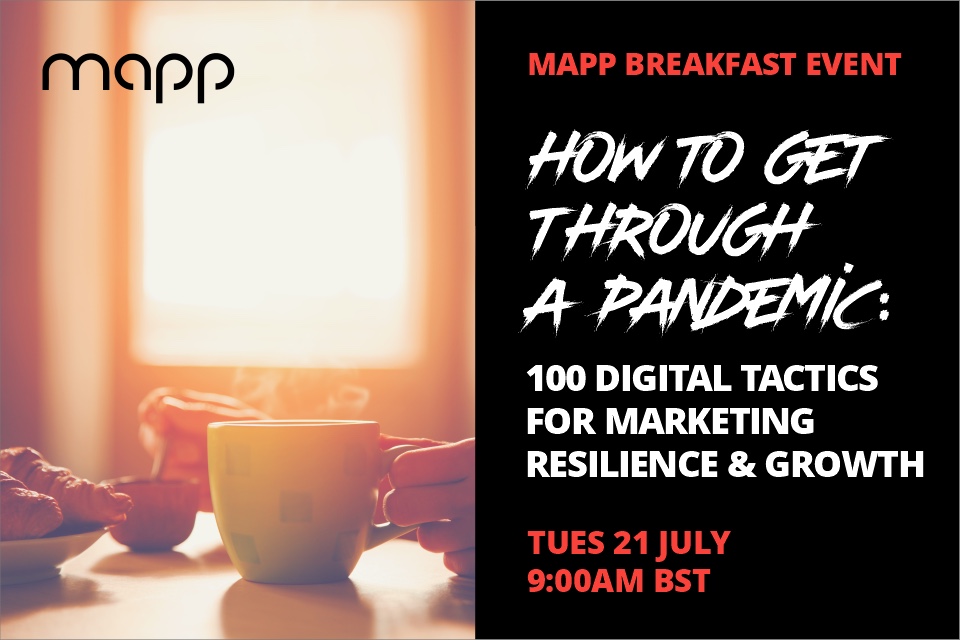
WEBINAR REWIND: 100 Digital Tactics for Marketing Resilience and Growth, with Mapp Digital

Don’t worry if you missed last week’s online breakfast webinar from Mapp Digital – You can now re-watch the entire session online!

With the emergence of Covid-19 and social distancing, many businesses have had to refocus on their online channels, accelerating the need for digital transformation and better marketing. But competition for online customers has increased. Are you just going through the motions, or are you actually optimising your digital activity? 

To help digital marketers in these uncertain times, Mapp has developed The Digital Marketing Playbook, an interactive guide featuring 100 tactics that are proven to bring results whatever marketing objectives you’ve set for your business. Not only will the Playbook help you to plan your digital programmes more effectively, but it will also help you to build marketing resilience and agility, two essential ingredients for thriving in rapidly changing environments. 

Mapp ran an online breakfast event to introduce the Playbook and take you through how to implement some of the most useful digital tactics that it features. 

Here’s what you will gain from re-watching this popular session:

  1. 100 different tactics and ideas on how to acquire, nurture, grow and retain customers
  2. Best practice on how to implement a selection of the best tactics
  3. Learn how to bake agility and resilience into your marketing programmes 
  4. Easily prioritise tactics focusing first on the ones that will bring the largest ROI with the least effort 
  5. A Costa Coffee eGift Card worth £8 if you attend the live webinar and are among the first 300 people that register.

The next great depression – Is your business ready?

We are living through extremely uncertain times regarding both public safety and the global economy. Even before the Covid-19 pandemic swept the world, we were teetering on the brink of a recession. Economists such as David Blanchflower compared the pre-Covid financial landscape to that of pre-banking crash 2008. If nothing else, this is a major red flag which should give you the motivation you need to take every possible measure to protect your business.

Is an international recession on the horizon?

At the very beginning of the year, the UN warned that we could be facing a global recession in 2020. That was before taking the impact of Covid-19 into account. Factors including trade wars, currency fluctuations, and Brexit were all amounting to an uncertain global economy and the Unctad report, “global growth will fall from 3% in 2018 to 2.3% this year — its weakest since the 1.7% contraction in 2009”.

Add the impact of Covid-19 to the already precarious situation, and we are now expecting to be hit with a recession rivalling even the magnitude of the Great Depression (and far worse than the 2008 financial crash). As of June this year, the global growth projection for 2020 has fallen to -4.9 per cent (1.9 per cent below the forecast made by the World Economic Outlook (WEO) in April). In addition, the road to recovery doesn’t look like it will be as fast as the WEO initially predicted, and they are now only forecasting a 5.4 per cent global growth for 2021, 6.5 per cent lower than the predictions before Covid-19. Low income households are expected to feel a particular acute financial impact, and global poverty, which has been significantly reduced since the 1990s, is likely to reach another crisis point.

Because of strain on the global economy, we are expected to encounter rising levels of debt in both developing and advanced countries, as well as a “global downturn that could increase unemployment and inequality”, as stated by Kristalina Georgieva of the International Monetary Fund. Redundancies and a decline in job vacancies on an international basis are expected to follow such a crash, with unemployment rates increasing at an alarming rate. 

How hard will the UK be hit? 

The OECD’s (Organisation for Economic Co-operation and Development) most recent reports do not look promising. Experts have predicted that the UK will likely be the worst hit country in Europe and the economy is forecasted to contract by 11.5 per cent after the first wave of the pandemic. If we end up seeing a second of Covid-19 later in the year, this contraction is predicted to increase to 14 per cent. 

One of the major reasons why the UK is likely to feel such a stark economic impact is our country’s reliance on the service industry for our economic growth, a sector which has been particularly damaged by the repercussions of Covid-19.

In addition to the economic factors surrounding Covid-19, the US trade war with China has caused a larger drag on global growth than anticipated, and the UK will be on the receiving end of the economic repercussions. What’s more, the looming prospect of Brexit poses different threats to the UK’s economy. At best, the uncertainty caused by both Brexit and the Covid-19 pandemic has created a hesitant consumer base in the UK. Customers are spending less and are more cautious of businesses than ever. It is a difficult time to maintain customer loyalty, as would-be consumers are tightening their purses in the fear of a looming financial disaster. 

Learn how to protect your business 

Times may be challenging, but if you think ahead, you’ll be able to safeguard your business against a recession. Businesses that prepare for every eventuality are the ones that not only survive but thrive in the face of adversity. Leaving it too late to implement a recession strategy could be your undoing, so get ahead of the game and prepare for a period of great financial difficulty. Here are some key strategies that will help your business face economic uncertainty:

  • Focus on existing customers — as we have discussed, consumers aren’t spending as much due to lack of trust and growing apprehension. Because of this, it is essential that you focus on your existing customer base during testing financial times. This will increase brand loyalty and grow customer confidence. Offer them benefits and reasons to stay true to your brand.
  • Put some adjacency and extension strategies in motion — a recession is not the time to start looking into completely new avenues of profit. However, you can’t let your services become stagnant. Adjacency strategy is the optimum solution to this — find an area adjacent to your core product or services to expand into. Extension strategy is similar: take your current service a little further and offer new and exciting opportunities or products to existing customers. Ensure that you have a flexed forecast so that the business is fully prepared for all possible outcomes of this new strategy.
  • Forge some powerful alliances — mergers, acquisitions, and alliances are all key strategies during a recession. Alliances offer a great way to expand your business without investing in anything completely new during times of uncertainty. 
  • Don’t be afraid to outsource — outsourcing key elements of your business can save you time, money, and financial anxiety during a recession. Outsourcing your accounts department may allow you create scale and flexibility within your organisation. 
  • Reduce inventory costs — look to see if your business has the leeway to reduce costs without sacrificing the quality of the services or products it provides. This will help to take the pressure off your finances. 
  • Don’t sacrifice your marketing budget — often, brands make cuts to their marketing budgets in response to financial anxiety. However, this will spell disaster for your company. There is no time more crucial to maintain your marketing efforts and show customers that your brand is tackling the recession and winning. 
  • Tighten up on your corporate governance — companies that see a downturn in performance are more likely to survive if they have good corporate governance embedded into their culture.  Part of this is ensuring that the company has had a financial audit. If in doubt, contact an accountancy from that specialises in audits, tax advice, and small business VAT.

No one knows quite what to expect over the coming months and years, but now is the time to start safeguarding your business against an imminent recession. The road ahead does not look easy, but if you put certain measures in place and react in a timely manner, there’s still time to recession-proof your business and come out on top. 

Sources

https://fullfact.org/europe/boris-johnsons-new-brexit-deal-four-key-questions-answered/

https://www.theguardian.com/business/2019/sep/25/global-recession-a-serious-danger-in-2020-says-un

https://www.theguardian.com/business/2019/sep/27/brexit-uncertainty-pushes-uk-to-brink-of-recession

https://www.forbes.com/sites/allbusiness/2014/11/12/5-ways-to-prepare-your-business-for-the-coming-economic-recession/#7c4089d34d4f

https://www.thebalancesmb.com/business-thrive-tough-economy-2948298

https://www.theguardian.com/business/2019/sep/09/kpmg-predicts-no-deal-brexit-recession-in-2020

https://unctad.org/en/Pages/publications.aspx

https://www.bbc.co.uk/news/business-52991913

https://www.imf.org/en/Publications/WEO/Issues/2020/06/24/WEOUpdateJune2020

https://www.theguardian.com/business/2020/jun/10/recession-uk-britain-coronavirus-developing-world-oecd

Marketing spend expected to rebound post-COVID

The latest IPA Bellwether Report asserts that ad and marketing spend will rebound in 2021, following budgets being slashed to their lowest levels in twenty years due to the impact of the coronavirus.

The net balance of firms that cut marketing budgets fell to -50.7% in Q2, down from -6.1% in Q1, with almost 64% of panel members having registered a decrease in spending compared to the first quarter, while only 13% posted an increase. These figures supersede the Report’s previous nadir of -41.7% evidenced in Q4 2008, following the global financial crisis.

The report says anecdotal evidence suggests that many businesses were focused on cutting costs amid the severe declines in revenue caused by the pandemic. Although firms utilised the UK government’s furlough scheme to ease the burden of staff costs, other reductions were required in order for many businesses to survive. Service sector companies faced particularly challenging circumstances, with little-to-no access to their clients amid enforced closures.

With coronavirus restrictions prohibiting anything other than small gatherings, funding for events marketing saw the sharpest reduction in the second quarter. A net balance of -76.6% of panellists registered a decline in events budgets, with more than 80% reporting a decrease. Just 3.6% posted a rise.

Main media advertising, crucial for brand exposure, also reported a steep decline in Q2. In fact, the reduction in budgets was the most severe since the survey’s inception, with a net balance of -51.1% of marketing executives seeing a decline in available spend. Underlying data within this main media category suggested the worst performing sub-category was out of home advertising (-61.2%). This was followed by audio (-50.0%), published brands (-49.2%), video (-39.3%) and other online (-35.1%).

Across each of the seven broad marketing types, direct marketing and public relations saw the joint-softest budget cuts in the second quarter, although with net balances of -41.6%, the downturns were still severe overall. Meanwhile, market research (-42.2%), sales promotions (-51.2%) and other marketing expenditure (-59.2%) each saw historic reductions for their respective categories.

Bellwether panellists remained pessimistic towards financial prospects in the second quarter of 2020, casting more downbeat assessments on both own-company and industry-wide finances.

Sentiment on own-company prospects plunged far deeper into negative territory compared to the first quarter, when the severity of the COVID-19 pandemic was only just beginning to become apparent. In the second quarter, precisely two-thirds of survey participants reported a pessimistic outlook for finances against 11.5% that expected an improvement, taking the net balance to -55.1%. The result represented the most severe degree of negativity since the fourth quarter of 2008 when the net balance measured -57.7%.

Reporting on industry-wide prospects, firms were also more pessimistic in the second quarter. In the latest survey period, 72.4% of businesses were pessimistic on financial prospects compared to just 6.4% that were optimistic. As a result, a net balance of exactly -66% of firms were downbeat, eclipsing the recent low of -42.0% registered in Q1. The latest reading pointed to the most negative outlook since the final months of 2008, at the nadir of the global financial crisis, when the net balance stood lower at -71.1%.

Following the global coronavirus outbreak and resulting lockdown measures, Bellwether author IHS Markit anticipates steep contractions in several key economic indicators during 2020. With many businesses temporarily closed throughout the majority of the second quarter, IHS Markit is expecting a -11.9% decline in GDP for the year as a whole. This forecast assumes that the gradual easing of UK lockdown measures continues over the coming months, allowing an increasing number of businesses to fully reopen and begin to claw back some of the lost revenue from the months of March, April and May.

Given the current economic climate, the Bellwether model points to a -11.3% reduction in adspend during 2020. However, this figure is heavily dependent on most sectors in the UK economy remaining open for the rest of the year, with a second wave of coronavirus infections a significant downside risk.

Looking forward, IHS Markit anticipates a robust recovery in macroeconomic conditions during 2021 as businesses move closer to operating at full capacity. This would translate into a predicted +4.9% expansion in GDP and implied adspend growth of +6.0%. Beyond that, it expects the economy to achieve above-average growth during a further recovery phase, before stabilising near long-run rates in 2024 and 2025.

Paul Bainsfair, IPA Director General, said: “As we suspected, these Q2 Bellwether figures reveal the very grave impact of COVID-19 on UK companies’ marketing budgets, financial prospects and employment plans. Understandably companies in the most severely disrupted sectors have had few options but to preserve cash and operations to survive until trading conditions are more benign. We can only hope that the range of Government aid – from VAT cuts to the Eat Out scheme, in addition to the furlough scheme and more, can help to facilitate this.

“While the future trajectory of the economy is unpredictable, however, that of brands starved of marketing investment is much clearer. Our evidence from previous recessions and periods of buoyancy consistently shows that cutting marketing investment weakens brands in the near-term and limits growth and profitability in the long-term.”

WHITE PAPER: Optimising your eCommerce site

By Kate Norton, Selesti

With so many businesses now needing their digital sales to prop up any bricks and mortar revenue more than ever, the landscape for eCommerce sites and the amount of competition is evolving every day. It’s vital therefore to ensure that your brand’s voice cuts through the noise. Simply having the best quality products, the widest range of options, or the lowest prices alone just isn’t enough. 

Growing your online income requires more than simply listing your products/services on your website and hoping your customers will find you. Whether you’re transitioning from the high street or looking to grow an already established website, or just starting out, ensuring you optimise your brand experience is key to increasing your footprint and reaching your eCommerce business goals. 

The first step for any successful online store is crafting a well rounded strategy that ties your marketing KPIs and objectives to your overall business objectives. Without a clear idea of how you see your business growing in the years ahead, it is impossible to effectively measure success. In our white paper we look at how to build your brand strategy using SMART goals, understanding the best channels to focus on, planning your marketing mix and building your brand with USPs and a value proposition.

Having the best strategy in place will only work, however, if you know your customers inside and out. What are they doing when they aren’t shopping with you? What real world issues are they concerned with, and how does your brand resonate with them? We cover how to ensure you have the right data for your customers, and where to find it, as well as how to grow your customer personas into usable resources for targeting your marketing and growing your revenue. Not only is it important to look at who your customers are, but also how they interact with your brand. We take a look at how to track your customers’ journey across multiple touchpoints and how to use this information to refine your tactics and address customer pain points. 

Finally, the look and feel of your site will have a massive impact on how customers view your brand. Issues with the user experience or overall site design can cause valuable consumers to disengage from your brand and move to the competition. We’ve included some best practice examples for optimising your website design to get you started. However, real success comes from testing your design. Our whitepaper aims to help you to understand the ways in which you can utilise user testing, heat mapping and screen recording, and A/B testing to increase your conversion rate.

In our whitepaper, we take a multi-disciplinary approach to your eCommerce website optimisation journey. Helping you to combine strategy, data and analysis, and iterative design testing techniques to continually drive the right people to your store and build revenue. 

Click here to download the White Paper.

Find your path to success at the Smarter Payments Summit

Have you secured your place at the upcoming Smarter Payments Summit? This event is now virtual, so you can attend remotely via a video link!

8th September – RSVP here to secure your place.

The Smarter Payments Summit is a highly focused event that brings the payments transaction industry together for virtual business meetings and interactive webinars.

Why attend?

– Pre-arranged online video meetings with solution providers of your choice
– Experience a virtual Forum from the comfort of your own working environment
– Attend a tailored programme of inspiring webinars
– Easily compare and benchmark potential products, services and solutions
– Attendance is entirely free of charge, which includes entry to our webinars

A more targeted approach

We understand that your time is precious, valuable and limited. You tell us who you want to meet, and we handle all the details. We arrange all meetings in advance based on your preferences, by providing you with details on solution providers, products and services.

Unique Virtual Summit Experience

Our event concept of pre-matched one-to-one meetings is facilitated by our proprietary matching software with live video meetings, enabling our live Forum experience virtually with five easy steps.

  1. Confirm your place at the Summit
  2. Let us know your future procurement trends
  3. Select the suppliers you wish to meet with
  4. Log on to your personal event itinerary page
  5. Click on video links to join meetings with buyers

Your complimentary ticket includes: An itinerary of one-to-one online video meetings with suppliers based on your requirements and upcoming projects, and a series of insightful and inspirational webinars.

Or if you have any questions then please do not hesitate to contact us today!

Digital Marketing Solutions Summit: There’s still time to claim your virtual place!

Have you secured your virtual place at the virtual Digital Marketing Solutions Summit taking place on Thursday 16th July?

Your attendance is entirely flexible and will allow you to source budget-saving and innovative solution providers to prepare for every eventuality.

Plus, you can enjoy all the benefits of the event from the comfort of your own home, including a series of LIVE webinars hosted by industry experts.

We only have a few virtual places remaining – RSVP here to secure your place.

WEBINAR REWIND: 5 Steps On How To Retain & Drive Customer Loyalty

If you missed last week’s Selligent webinar on how to retain & drive customer loyalty, don’t worry – You can re-watch the entire session online!

Understanding what your customers love most about your brand is the foundation to driving a successful loyalty program. Acquiring new customers can be time consuming and expensive. So once brands have worked hard to grow their loyal customer base, how do they then keep them that way – and why is it even more important during times like these?

The latest webinar in Selligent’s Masterclass series saw the company’s Director of Marketing for Northern Europe, Sam Counterman, and Customer Success Manager, Taylor Whiteley, outline five steps brands and marketers can take to develop a successful customer loyalty program.

Topics included:

  • Brand Loyalty: Short- and Long-term Strategy
  • Moments of Impact: Understanding the Customer Journey
  • Universal Consumer Profile: Customer Data Segmentation
  • Utilising Mobile Push: Omnichannel Communication
  • When and how to add value when it matters most

Click here to WATCH AGAIN!

Elite Business: The only platform of resource for business growth

At Elite Business, we’re passionate about championing new business. Providing fresh perspectives and representing disruptive solutions, we’re interested in the startups and SMEs that are spearheading Britain forward. From tech unicorns to entrepreneurs transforming healthcare with AI, we cover the movers and shakers making enterprising exciting.

Our online platform covers up-to-the-minute content and presents a unique angle on the things enterprises need to know, from maximising the potential of mobile to setting the world alight on social media. We also gather the best and brightest voices in the community to share their experience. To get the latest information click the link below and subscribe to exclusive updates in the industry.

Click here to subscribe today!

Do you specialise in Web Analytics? We want to hear from you!

Each month on Digital Marketing Briefing we’re shining the spotlight on different parts of the print and marketing sectors – and in July we’ll be focussing on Web Analytics.

It’s all part of our ‘Recommended’ editorial feature, designed to help marketing industry professionals find the best products and services available today.

So, if you specialise in Web Analytics solutions and would like to be included as part of this exciting new shop window, we’d love to hear from you – for more info, contact James Howe on j.howe@forumevents.co.uk.

Here are the areas we’ll be covering, month by month:

Jul – Web Analytics
Aug – Conversion Rate Optimisation
Sep – Digital Signage
Oct – Brochure Printing
Nov – Creative & Design
Dec – Online Strategy

Digital Marketing Solutions Summit: Claim the last places

Have you secured your virtual place at the virtual Digital Marketing Solutions Summit taking place on Thursday 16th July?

Your attendance is entirely flexible and will allow you to source budget-saving and innovative solution providers to prepare for every eventuality.

Plus, you can enjoy all the benefits of the event from the comfort of your own home, including a series of LIVE webinars hosted by industry experts.

We only have a few virtual places remaining – RSVP here to secure your place.