Digital Marketing Solutions Summit | Forum Events Digital Marketing Solutions Summit | Forum Events Digital Marketing Solutions Summit | Forum Events Digital Marketing Solutions Summit | Forum Events Digital Marketing Solutions Summit | Forum Events

All

Meet with the UK’s leading marketing solution providers this May

Have you secured your complimentary guest pass to attend the Digital Marketing Solutions Summit – You’ll be joining 60 of your marketing industry peers!

12 May – Hilton London Canary Wharf

Register here for your complimentary pass, which includes an itinerary of 1-2-1 meetings with budget-saving suppliers, access to insightful seminars, networking opportunities, plus lunch and refreshments.

You’ll join fellow senior marketing professionals who share your goals and challenges. They include executives from:

ABTA
Advanced Diesel Engineering
Ambassadors Theatre Group
Audible
Blackbird
Bondi Sands
Bouygues Energies & Services UK
Care UK
Carnival UK
Conde Nast
Corinthia London
Cyber Smart
Dufry
Four Seasons UK Collection
FTA
Great British Chefs
Jordan’s Dorset Ryvita
JustGiving
L&Q
LifeSearch
LV=
Oxfam
Prospect Magazine
Pwc
Raremark
Saga Services
Simply Business
Sky UK
Stadium
Swatch Group
Swift Direct Blinds
University of Sunderland London
University of West London
Weight Watchers
WSP
Yarmouth Stores Ltd & Kirklands

Would you like to join them? Ensure you claim your guest pass here!

Print & Digital Innovations Summit: have you secured your place?

This November the Print & Digital Innovations Summit will once again allow senior print and marketing professionals to meet with innovative and competitive suppliers to the industry – don’t miss out!

12 November – Hilton London Canary Wharf

It is entirely free for print and marketing professionals to attend and, as our guest, you will be provided with a bespoke itinerary of pre-arranged, face-to-face meetings with suppliers who match your requirements and upcoming projects.

During the course of the event, you can also attend insightful and inspirational seminars from industry thought-leaders. And there are plenty of opportunities to network with like-minded peers who share your challenges.

Lunch and refreshments are also included with your free ticket. Simply register your place here.

To find out more about attending, contact Remi Vince on 01992 374064 / r.vince@forumevents.co.uk.

If you’re a supplier to the sector, contact James Howe on 01992 374067 / j.howe@forumevents.co.uk to find out about the range of event partner packages.

Do you specialise in Email Marketing solutions? We want to hear from you!

Each month on Digital Marketing Briefing we’re shining the spotlight on different parts of the print and marketing sectors – and in March we’ll be focussing on Email Marketing.

It’s all part of our ‘Recommended’ editorial feature, designed to help marketing industry professionals find the best products and services available today.

So, if you specialise in Email Marketing solutions and would like to be included as part of this exciting new shop window, we’d love to hear from you – for more info, contact James Howe on j.howe@forumevents.co.uk.

Here are the areas we’ll be covering, month by month:

Mar – Email Marketing
Apr – Digital Printing
May – Social Media
Jun – Brand Monitoring
Jul – Web Analytics
Aug – Conversion Rate Optimisation
Sep – Digital Signage
Oct – Brochure Printing
Nov – Creative & Design
Dec – Online Strategy

Half of small marketing businesses predicting Q1 growth

Two in five small business leaders (39%) predict growth by 31 March – the highest level for 18 months, according to new research from Hitachi Capital Business Finance.

By industry sector, this quarter sees a rise in growth outlook registered across the board in all but two sectors, with a significant upturn of growth projections in real estate (49%), IT and telecoms (49%), legal (47%) and media (46%). 

In recent weeks, there has been widespread speculation on the likely impact of Brexit on the UK business community. The new data suggests smaller businesses are more likely to see uncertainty as an opportunity. Seasonal businesses, those that live with change and the need to adapt on a regular basis, are more likely to predict growth for the months ahead (40%). Also, small firms that invest in their technology assets are more likely to foresee opportunities to adapt and grow (47%).

Regionally, small businesses in the East (43%) join London (47%) and the North West (45%) as having the most businesses with a positive outlook for the months ahead. Over the last 12-months, there has been a significant upturn in growth predictions in London (rising from 36% to 47%), the South West (from 29% to 38%) East (28% to 43%). In contrast, small enterprises in Wales and Scotland were the least likely to predict growth.

Interestingly, older businesses (those that have been trading the longest) demonstrate the biggest surge in growth outlook, suggesting a willingness to adapt to change. The ‘confidence gap’ between younger and mature businesses shows clear signs of closing. 

Percentage of businesses predicting growth to 31 March by age of business (how many years it has been trading)

 Less than 5 years5-10 years10-20 years20-35 years35+ years
Q1 202045%36%38%34%37%
Q4 201945%38%34%24%26%
Q1 201949%34%33%30%30%

Gavin Wraith-Carter, Managing Director at Hitachi Capital Business Finance said: “As the UK economy enters a new chapter, the latest findings from our quarterly tracking research suggest that UK small businesses are starting a new year, a new decade and a new economic era with a positive outlook. What is heartening is the diversity of this confidence, which spans regions, sectors and older businesses modernising.“At Hitachi Capital Business Finance we are producing a new series of training and support guides to help small business manage their enterprises through the Brexit transition period. In addition, our smart funding solutions give small businesses greater flexibility in the way they manage their cashflow and help their enterprises through seasonal highs and lows. The UK economy is going through a period of uncertainty – at Hitachi Capital Business Finance we are helping small businesses to live with uncertainty and to see it as an opportunity to innovate and grow.”

Additional Tables Percentage of businesses predicting growth to 31 March by sector

Percentage of businesses predicting growth to 31 March by sector

 Q1 2020 Net % that predict growthQ4 2019 Net % that predict growthQ3 2019 Net % that predict growth Q2 2019 Net % that predict growth
Finance & accounting49%47%48%33%
Real estate49%43%32%45%
Retail31%39%34%40%
Manufacturing44%39%30%38%
Media & marketing46%38%37%36%
Hospitality & leisure33%37%27%29%
IT & telecoms49%36%41%38%
Construction33%32%26%31%
Legal47%30%44%41%
Transport & distribution34%29%27%25%
Agriculture29%25%32%27%

Net percentage of businesses predicting growth – results over time

 % that predict net growth (significant or modest/organic) 
Q3 201836%
Q4 201836%
Q1 201936%
Q2 201934%
Q3 201935%
Q4 201936%
Q1 202039%

Percentage of businesses predicting growth by region

 Q1 2020%that predict growthQ1 2019%that predict growth
London 47%36%
North West45%44%
North East44%51%
East43%28%
Yorkshire /Humber39%35%
South West38%29%
East Midlands38%42%
West Midlands34%35%
South East34%40%
Wales30%30%
Scotland30%31%

Instagram ‘attracting a larger audience than Facebook’ among brands

Instagram has a larger audience and nearly 20X more interactions than Facebook among top 50 brand profiles, according to Socialbakers’ new Q4 2019 Trends Report.

Key insights from the report include Instagram overtaking Facebook in audience size, the relative decline in engagement during the holiday season, the popularity of vertical videos, the dominance of women among fans and followers, growing ad spend, and the continuing explosion of influencer marketing. 

“The writing has been on the wall for some time, but now it’s official. When it comes to the top 50 biggest brand profiles, Instagram has a larger audience than Facebook,” said Yuval Ben-Itzhak CEO, Socialbakers. “That development was not a surprise. What was unexpected in Q4 2019, however, was the relative decline in engagement during the holiday season. This is a warning sign that brands require a deeper understanding of which types of content their audiences find compelling, and an agile method to get that content in front of them.”

The key findings of the Q4 2019 Trends report include:

·         For the first time globally, Instagram surpassed Facebook in audience size – but for the top UK brand profiles, Facebook still has a marginally bigger audience, but greater engagement is found on Instagram

·         Despite efforts to attract consumers during the holiday period, post interactions for both Instagram and Facebook were lower in Q4 2019 than Q4 2018

·         Women make up the majority of fans and followers of brand pages on Instagram and Facebook, representing over half (56.4%) of the audience engaging with brands

·         Whilst 70% of videos on Facebook brand pages are shot horizontally, viewers are more likely to complete a vertical video than horizontal (29.9% vs. 22.2% respectively)

·         Ad spend on Instagram Stories increased by 40% over the last year, and by 91% over the last two years. Meanwhile, in the UK, brands are still posting more to the Instagram News Feed

·         The number of influencers using #Ad exploded by 90.5% in Q4 2019

·         The Services category (including lawyers, accounting services and IT services) found a 66.7% jump in engagement

Based on the top 50 biggest brand profiles worldwide, there was a notable change in Q4 2019. For the first time, the total audience on Instagram surpassed the total audience size on Facebook. Additionally, the total interactions on Instagram were nearly 20 times larger than those on Facebook. So, even though the top 50 brands published more posts on Facebook, the engagement on those posts didn’t reach the numbers that Instagram was able to achieve.

For the top UK brand profiles Facebook still has a marginally bigger audience. However, while brands are posting roughly the same amount of content to Facebook and Instagram, they are seeing significantly more engagement on Instagram. The lesson here is that UK brands need to focus on their Instagram strategy as by splitting their content between both platforms they are likely leaving interactions on the table. 

Engagement: A surprising drop in interactions

In the UK the industries that are seeing the most engagement across Facebook and Instagram are ecommerce, fashion and retail. The data shows that ecommerce brands are really leveraging the potential of Facebook, whilst Fashion brands are running the show on Instagram. 

Despite attempts to attract consumers during the holiday season, the relative post interactions for both Instagram and Facebook were lower in Q4 2019 than a year ago. This was true even among the most successful industries on social media. Fashion, the top industry on Instagram, decreased by 19.4%, while the top industry on Facebook, Ecommerce, decreased by 9.6% versus Q3 2019. This may indicate that brands need to get smarter about the content they post, and focus on top quality content in smaller volumes to increase engagement.

However, one interesting success story in Q4 engagement is the Services category. It achieved a 66.7% jump in engagement on Instagram compared to Q3 2019. On Facebook, Services finished fourth with 7.6% of total interactions after not making the top eight in the previous quarter. Services is a wide-ranging category that includes lawyers, accounting services, hairdressers, car repairs, IT services, conference and event organisers, and weight loss courses.

Format: Vertical videos pull viewers in

Marketers often wonder whether viewers prefer videos that were shot horizontally or those that were shot vertically. Currently, about 70% of videos on Facebook brand pages are shot horizontally. But according to Q4 data from those Facebook brand pages, vertical videos perform better than horizontal videos across the board. For videos shorter than 30 seconds (which is the most popular video length), vertical videos were completed by viewers 29.9% of the time, while horizontal videos were completed 22.2% of the time. 

Demographics: Women are dominant on social media

According to the Q4 2019 data, women make up the majority of fans and followers of brand pages on both Instagram and Facebook. On Instagram, 58% of brand page followers were female, comprising the majority of every age demographic. On Facebook, women made up 56.7% of the total audience of page fans, although there were slightly more men in the 18-24 age demographic. Women are also the largest group of people mentioning and interacting with brand pages in the prime marketing demographic of 25-34. Overall, women represented 56.4% of the audience engaging with brands in Q4 2019.

Ad spend: Instagram rises but Facebook remains the leader

As in past quarters, ad spend on Instagram Stories continues its rapid growth, although Facebook Feed remains the leader with 58.3% of total ad spend. For the first time, Instagram Stories reached 10% of ad spend in the second half of 2019. Overall, the spend on Instagram Stories increased by 40% over the last year, and by 91% over the last two years.

In the UK the data shows that brands are still posting more to the News Feed. Since Stories are proving to be a highly engaging content format globally, perhaps UK brands need to up their game on Stories. 

Other ad spend trends include the rise of Instagram Explore and Facebook Marketplace as a destination for advertising dollars. In its first five months, the percentage of ad spend on Instagram Explore grew to 1.32%. And over the last year, ad spend on Facebook Marketplace grew from 0.72% in December 2018 to 1.31% at the end of 2019, an increase of more than 80%.

Influencer marketing: No sign of slowing down

One trend that remains unchanged is the skyrocketing growth of influencer marketing. In Q4 2019, the number of influencers using #Ad or the local language version in their posts exploded by 90.5%. For the third straight quarter, the top Instagram brand profile in the world associated with influencers was Walmart, which had 854 mentions from 619 influencers in Q4 2019. Other profiles with successful influencer partnerships included Daniel Wellington, iDeal Of Sweden, and FashionNova.com.

The complete Q4 2019 Social Media Trends Report with supporting graphics is now available for free download.

Glenigan B2B Audience Targeting – Case Study

Glenigan is an information services company for the construction industry who supply detailed information about construction projects in the UK via a subscription service. Clients include construction firms, mid-sized and large contractors, and the manufacturers/suppliers of building materials and services. Glenigan has the most accurate and comprehensive database of construction sales leads in the UK, and their information helps their subscribers win contracts and gain insight into the construction market. 

Challenge

Glenigan had been running paid search campaigns with some success, but wanted to increase their number of qualified leads year on year. They also wanted to drive greater efficiency from paid media channels so that they could achieve a lower CPA and get the most from their marketing budgets. Paid search formed an important part of Glenigan’s digital channel mix, so it was vital to the client that the channel was reaching the right audience, high quality leads were being generated for the sales team, and efforts weren’t being wasted on consumer traffic.   

With this brief, we set about creating a plan which would help Glenigan connect with their target audience and improve the performance of their paid search campaigns.  

Solution 

Our first move was to make sure that paid search activity was connecting with quality users. We knew that we needed to reach a B2B audience, and (where possible) limit exposure to consumer traffic. 

We took measures to analyse campaign performance by both time of day and day of week, and ensure that the account’s budgets were aligned with performance. Running campaigns during trading hours only greatly improved spend efficiency, and within these hours we were able to find additional pockets of efficiency in which we could adjust our bidding accordingly. 

To help further refine our paid search targeting, the team also took advantage of audience demographic information so that we could identify areas of wasted spend, and areas of opportunity. We examined campaign performance by factors such as age, gender, and user household income to make sure that we limited ad delivery to those not interested in Glenigan’s proposition. Conversely, we were then able to maximise our efforts on audience demographics who responded well to our ads, and were likely to result in a qualified lead.

In addition to demographic audience analysis, we then started to run several in-market audiences on groups we believed to be similar to Glenigan’s target customers. By observing the behaviour of relevant groups – such as users in the market for general contracting services – we were able to set bids based on their performance.

Taking it a step further, we were also able to help the client install website tracking so that we could keep track of users who were already Glenigan subscribers. With this information we excluded current customers from our prospecting campaigns to reduce wasted spend on users who were simply looking to log in to the website’s subscriber area. We also started to bid more aggressively on returning site visitors who were yet to convert, as our analysis showed that they were much more likely to convert compared with cold leads.    

Results

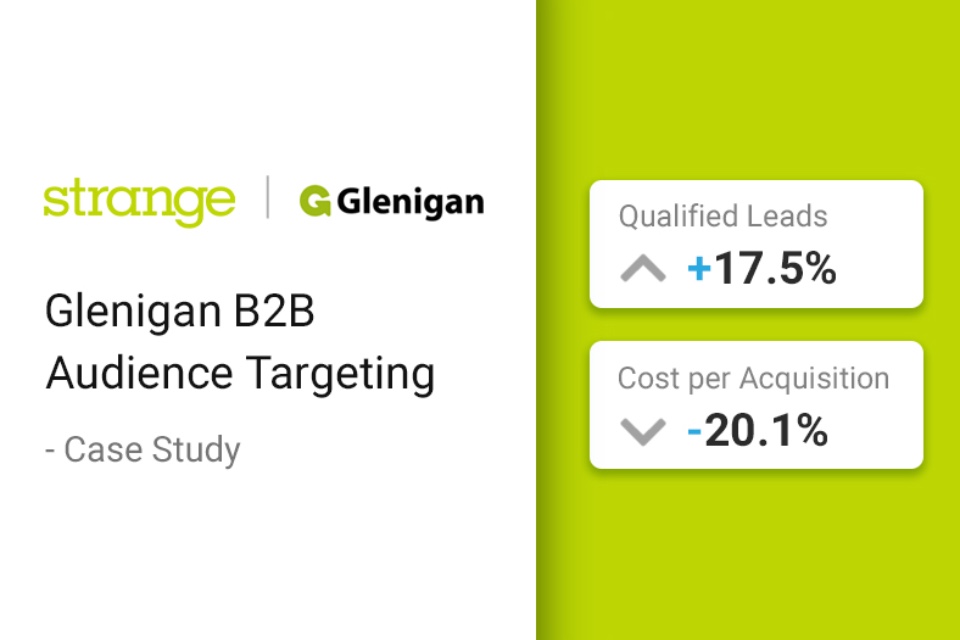
The result of our audience refinement work were significant improvements in account performance and overall lead volume. From paid search we generated a 17.5% increase in qualified leads, comparing the first half of 2019 with the first half of 2018. 

Over the same period, we were also able to decrease Glenigan’s cost per lead by 20%. Furthermore, the client saw these improvements without increasing their marketing budget between the two periods, meaning that overall efficiency was greatly improved.

Ian Bellamy, Head of Marketing at Glenigan, said: “Strange has helped us to spend our paid search budget much more efficiently and effectively. We’ve managed to spend less and achieve more through improvements in both the volume and quality of leads. The team has made a real positive impact, not only are they focused on delivering improved business results, they’re also a great team to work with and a valuable extension to our internal team. Highly recommend.”

Read more about Strange here

SAVE THE DATE: Print & Digital Innovations Summit

The Print & Digital Innovations Summit is a unique one-day event which allows senior print and marketing professionals to meet with innovative and competitive suppliers to the industry.

12 November – Hilton London Canary Wharf

It is entirely free for print and marketing professionals to attend and, as our guest, you will be provided with a bespoke itinerary of pre-arranged, face-to-face meetings with suppliers who match your requirements and upcoming projects.

During the course of the event, you can also attend insightful and inspirational seminars from industry thought-leaders. And there are plenty of opportunities to network with like-minded peers who share your challenges.

Lunch and refreshments are also included with your free ticket. Simply register your place here.

To find out more about attending, contact Remi Vince on 01992 374064 / r.vince@forumevents.co.uk.

If you’re a supplier to the sector, contact James Howe on 01992 374067 / j.howe@forumevents.co.uk to find out about the range of event partner packages.

Can you help buyers looking for these marketing solutions?

We will have around 60 senior marketing professionals attending the Digital Marketing Solutions Summit in May.

They are attending to source new suppliers – can you help?

Specifically, these buyers are looking for suppliers in the following categories (% of delegates looking for those solutions):

  • Content Management – 43%
  • Conversion Rate Optimisation – 40%
  • CRM – 40%
  • Customer Engagement – 51%
  • Email Marketing – 49%
  • Landing Page Optimisation – 40%
  • Lead Generation & Tracking – 46%
  • Multi-Channel Engagement – 37%
  • Online Advertising – 46%
  • Online Marketing Campaigns – 40%
  • Pay Per Click – 37%
  • Search Engine Optimisation – 40%
  • Social Media – 49%
  • Strategy Marketing – 57%
  • Web Analytics – 37%

If you operate in any of these areas and would like to join us May 12th at the Hilton London Canary Wharf, get in touch today!

Alexa, do I need a voice search strategy? – Why your business should consider the merits of implementing a voice search strategy

With voice search dominating the realm of SEO and business news, Jimmy McCann, Head of Digital Strategy at international digital marketing agency, Search Laboratory, discusses how voice search is becoming the default search method for consumers worldwide and why voice search shouldn’t be overlooked as part of a business’ digital strategy.  

Implementing voice search technology 

With recent partnerships being established in the world of voice search, such as the NHS and Amazon, this only scratches the surface of voice technology. The possibilities are endless and this partnership only works to emphaises the technology is here to stay, with more and more consumers creating demand for home voice assisted devices, including Amazon’s Echo and Google Home. 

In turn, a growing number of brands are turning to SEO specialists to improve their search engine results page (SERP) ranking due to the rising popularity of voice search amongst consumers. The popularity is bound to lead to an even greater influx in brands looking to gain market share and a slice of the action. 

Of course, as with any strategy, voice search can’t just become a ‘me too’ exercise for brands. Rather, the approach must be considered and highly strategic. There are many reasons why it is becoming necessary for some brands to adopt voice strategies, but rather than panic and invest in this new technology without thought, it is essential those looking to integrate voice search within their existing offering – like the NHS – to do so in a way that ultimately works to benefit the consumer and the broader business strategy. 

The impact of voice search on SEO

That said voice search is a hugely popular emergent technology that will only keep getting bigger. As it does grow, the way SEO is conducted will be impacted, and this is where larger numbers of businesses that don’t necessarily see a need for voice search considerations as part of their digital strategy may become impacted.  

Voice technology isn’t new by any means. In fact, it was first designed in the 1950s but with the new home assistant device, it has taken a place in the forefront of consumer minds. The technology is improving at such a rapid pace that it is constantly interesting consumers. Just like social media and smartphones, voice technology is here to stay in the consumers everyday life. 

Businesses who want to remain visible to consumers in the coming years will have to find a way to incorporate voice technology, or at the least an SEO approach that considers the nuances presented by voice search, into their digital marketing strategies. 

With voice searches, users do not see a full SERP and decide from there which link to click, but rather are presented with the top result or answer spoken back to them. As such, businesses will no longer be fighting for a place of page one, but rather for the top result every time, for every search term. 

Using voice to enhance the customer experience 

Voice does also offer other benefits for businesses. Building a voice search strategy isn’t just about remaining relevant – it is also about creating a unique customer experience that will build on relationships first made via computers and ultimately, build brand loyalty. The most sophisticated home assistants such as Alexa and Google Home can tell the difference between voices asking questions. This means that they can provide valuable insights about specific users that can lead to more personalised content for the consumer. 

Eventually it is predicted that voice technology will also allow brands to interact with consumers in a more natural and seamless way, with the aim of encouraging customer retention and loyalty. Finally, voice search interactions take far less time than text-based ones, which makes life more convenient for busy consumers who expect a quality experience and instant gratification every time they interact with a brand. Customers want brands to stay on the fringes of their life until needed, at which point they want immediate support and service.

As voice technology continues to grow and become more popular among consumers, it will become increasingly important for businesses of all shapes and sizes to include a voice search strategy into the overall digital marketing plan. 

Along with already changing the way people approach SEO, voice search is also giving businesses an opportunity to create an enhanced customer experience, and brands that want to compete and stay relevant will have to get on board.

Beyond that, voice search could also prove to be a great tool for increasing web traffic and beating the competition, as long as businesses have a solid voice-optimised SEO strategy in place to get their brand to the top of the SERPs. 

Using Facebook for marketing success

By Strange

What’s the main focus of your digital marketing strategy? At one time, everyone would have said Google. These days, however, Facebook has become a credible alternative for many businesses. As an agency, we’ve developed considerable resources and capabilities to service the huge growth in clients’ use of the platform.

You may already appreciate the sophisticated features and capabilities combined with enormous reach and powerful targeting that Facebook offers. These can deliver great returns for almost any brand or organisation, whether used for acquisition, awareness or direct response, for example.

Being a Facebook Marketing Partner certainly helps us deliver better value for clients. Facebook defines Marketing Partners as “tech companies and agencies that have been vetted by Facebook and certified for their excellence in helping advertisers get the most from their campaigns.” 

New insights on the Facebook Auction 

As a Marketing Partner, we can access information and insights from Facebook that may not be widely available. In this article we’re sharing some valuable information we were recently given on the Facebook Ad Auction. We hope this helps make the auction process work better for you.

The Facebook Auction is the process by which Facebook’s algorithms spend advertising budgets in the most effective way possible. How these auctions work has, for a long time, been somewhat opaque, but Facebook has now started to release more information about how the system works.

1. Simplify your campaign structure 

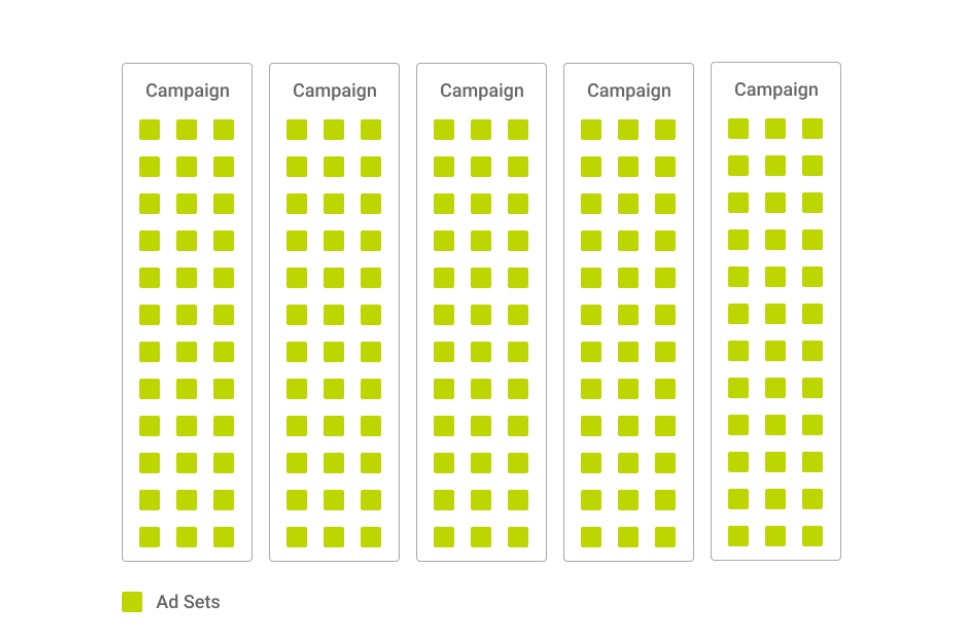
A typical Facebook account structure looks something like this. It can have multiple campaigns organised into different marketing approaches, strategies or tactics. Campaigns are subdivided by highly defined, narrow audiences at ad set level.

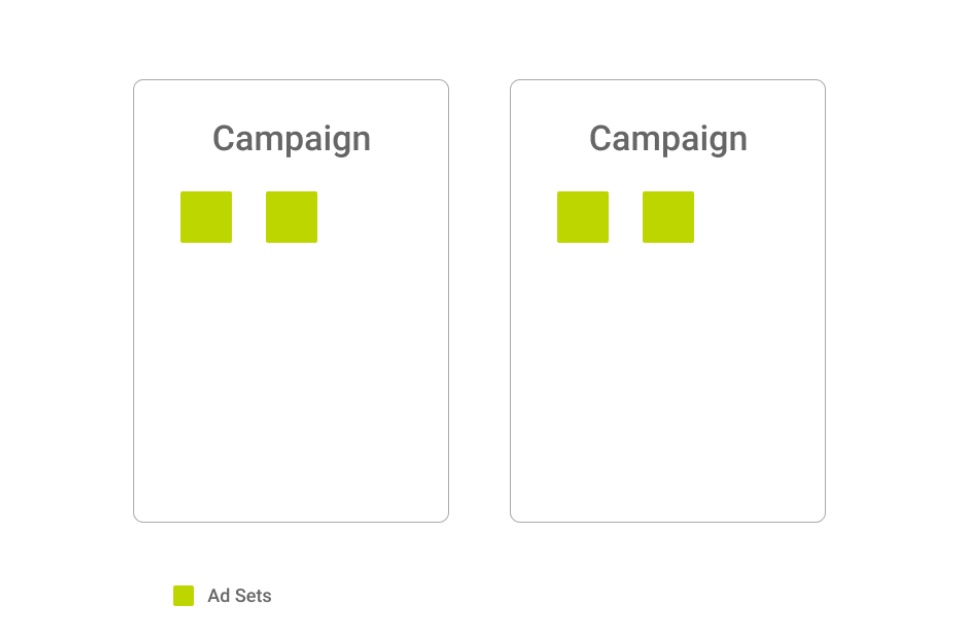
But if your account structure could look like the one below, Facebook claims that a simplified and consolidated structure leads to what they call increased ‘auction signal’, i.e. it increases the available signals Facebook’s algorithm has to work with when it decides where and how to deploy budget. 

Combining your campaigns and ad sets into larger buckets helps because it removes constraints on the system so that it can search for the best areas of opportunity within larger groups of people, instead of being restricted to granular, pre-defined audiences.

The primary benefit of a consolidated account structure, however, is that it will help drive a faster exit from Facebook’s ‘learning phase’ because the algorithm has more information to work with.

2. Respect the learning phase

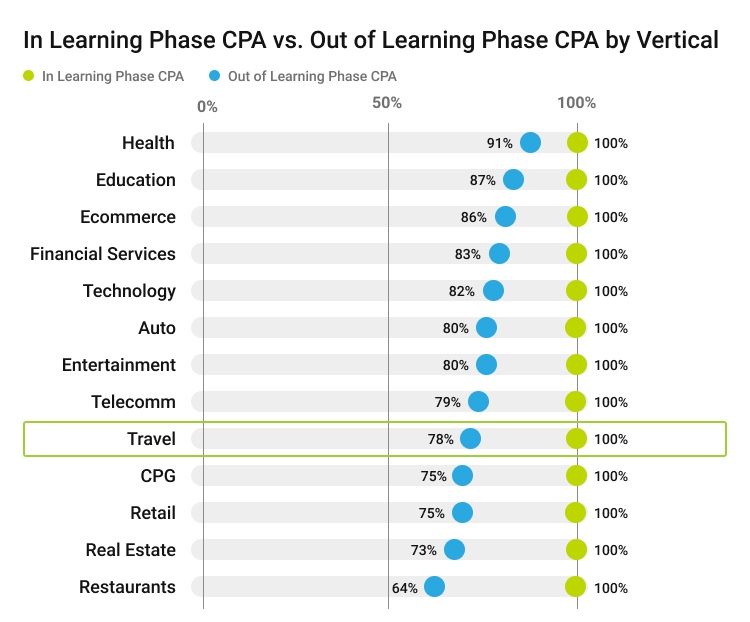
Facebook’s learning phase is when the delivery system explores the best way to deliver your ad sets after launch. This means that performance is less stable, and CPAs will actually be worse during this time because the engine is still working out the best people and places to show the ad. Anything that you can do to exit the learning phase earlier will therefore help to improve overall campaign performance. 

Fortunately there are some straightforward rules you can follow to make sure your campaigns have enough data to exit the learning phase in a timely manner. For instance, making sure that your targeting and placements aren’t too narrow will really help give the auction more signal. 

It’s also very important that you optimise for the right conversion event. If you’re optimising for a conversion event which is too far along the funnel for you to reach a sufficient number of conversions, try switching to something which will record more conversions – for example, optimising for ‘Add to Carts’ instead of ‘Purchases’. A higher number of conversion events will ultimately help you get past the learning phase threshold and improve overall optimisation.

One last critical piece of advice: do your best to avoid frequent manual edits! Whilst it may be tempting to constantly tune and tweak your campaigns, making significant changes can reset the learning phase so that the algorithm has to start all over again. Any changes to the following can cause your campaigns to re-enter the learning phase:

  • Targeting
  • Placements
  • Creative (including adding additional ads)
  • Optimisation events
  • Pausing your ad set for more than 7 days
  • Bid strategy
  • Budgets

Key takeaways

  1. Consolidate your account structure for maximum auction signal
  2. Give the Facebook system as many data points as possible so that it can exit the learning phase quickly
  3. Don’t narrow your targeting too much and optimise for the right conversion events to reach the learning phase threshold
  4. Avoid frequent manual edits so that your campaigns don’t re-enter the learning phase

Continuing to evolve

Facebook has come a long way since its Marketplace was originally launched in 2007. Back then we were helping clients use the brand new channel (we’re now celebrating our 20th anniversary as an agency) and we’ve been keeping abreast of Facebook’s evolution ever since.

Future changes are inevitable. However the platform shapes itself in the future our focus as an agency will always be on working in partnership with Facebook to bring greater value to our clients.

Read more about Strange here