
Digital Marketing Solutions Summit | Forum Events Digital Marketing Solutions Summit | Forum Events Digital Marketing Solutions Summit | Forum Events Digital Marketing Solutions Summit | Forum Events Digital Marketing Solutions Summit | Forum Events

Posts By :

Stuart O'Brien

2D Codes: Preparing for the new dimension

After successful implementation in sectors including tobacco and pharmaceuticals, two-dimensional barcodes or ‘2D codes’ are gaining prevalence across industries and are expected at the point of sale within the next five years. The growth in 2Dcodes presents significant opportunities for manufacturers but is not without its risks.

As James Cutforth, Domino Printing Sciences, explains, preparing for the new dimension in barcodes requires bespoke product handling solutions, designed to facilitate crisp, clear coding on a range of products and packaging types…

A new dimension in barcodes

Two-dimensional barcodes have become a common addition to product packaging – with factors such as globalisation, online trading, and the need for more robust anti-counterfeit methods driving their uptake. In several industries, including European tobacco and pharmaceuticals, 2D codes are now a regulatory requirement.

Such is the success of 2D codes that in May of 2020, global standard organisation GS1 began an initiative to support the adoption of 2D codes at the point of sale (POS) with a new barcoding standard – the GS1 Digital Link. The standard will facilitate the use of 2D codes at POS systems and allow for a gradual transition away from standard linear barcodes.

There are multiple benefits to using 2D codes in place of traditional linear barcodes2D codes enable more information within a single code, including dynamic data, and can facilitate serialisation and wider traceability. However, the complex nature of 2D codes also presents some challenges.

The challenge behind 2D codes

It is imperative that 2D codes are printed correctly to ensure that they can be effectively scanned – this is particularly crucial when using 2D codes for regulatory purposes, such as those used in pharmaceutical applications, and will be increasingly important when considering 2D codes for use at POS.

Utilising variable 2D codes on products can provide significant benefits to manufacturers in terms of facilitating better supply chain control, however, applying the code to packaging that has been packed or filled can be challenging.

Dynamic data, such as batch-related information (including batch numbers, and ingredient variations including nutrition and allergen info), product expiry dates, and unique product IDs, will require real-time, on-product coding, rather than pre-coded labels. In such instances, simply ‘bolting on’ a coding device to an existing production line may not be optimal because often, production machinery is not designed with coding in mind.

For this reason, product handling or the ‘presentation of the product’ to the coding device is fundamental to achieving high-quality codes. Manufacturers that choose to code products in-line without effective product handling will be subject to production line variations which can affect final code quality, including:

  • Product position: Small variations in the position of products may result in codes applied in the wrong area or missing or incomplete codes.
  • Product distance from the printer: Positioning too close or too far from the coding device can result in blurry or unreadable codes.
  • Product angle: A slight rotation in product positioning can result in deformed codes, even if this is by just a few degrees.
  • Line speed: Minimal speed fluctuations will affect the quality of the code, leading to squeezed or stretched codes.
  • Conveyor vibrations: At high speeds, minimal vibrations can affect code quality leading to low-quality, blurred, or wavy codes.
  • Challenging product geometry: Certain packaging types can be a challenge for a standard coding setup.

At best, a poor quality 2D code resulting from inadequate product handling will cause a high number of rejections, rework, and defective stock. Poor quality 2Dcodes can also have a knock-on effect on lines that require the aggregation of serialised products. The repercussions can be even more severe if an unreadable 2D code leaves the factory unnoticed. Brands can face financial penalties such as fines, as well as loss of business, product recalls, and potential legal implications.

What’s the solution?

A bespoke product handling solution can solve all issues above concerning code quality by ensuring optimal and consistent product delivery to the coding equipment. The optimal solution will be designed based on several different considerations, including:

  • Product and packaging type: Factors such as the shape of a piece of packaging, substrate type, and weight of a filled pack can be crucial. In pharmaceuticals, for example, boxes of blister packs are light and have regular form, but glass or plastic medicine bottles will be more challenging to code.
  • Code requirements: Code type, placement, and resolution are determining factors. Many machine-readable codes have minimum size requirements and necessitate the use of high-resolution printing technologies.
  • Existing production specifications: If a coding solution is integrated into an existing production line, it will need to be designed with existing specifications in mind so as not to slow down production or reduce overall equipment effectiveness (OEE).

A bespoke solution may use multiple types of technology to handle finished products and present them to the chosen coding device for final printing, including specialised conveyors, wheels, or product carriages and movers such as robotic arms, depending on the product type. These devices can use different methods to handle products with varying levels of force for delicate and robust products alike. A bespoke handler could be developed with pneumatic or servo-electric driven side-, top-, or bottom belts, or even magnetic or vacuum solutions.

As well as improving overall code quality, bespoke product handling solutions can also be developed to allow additional processes to enable pre- or post- treatment of a substrate, where necessary. When used alongside machine vision systems, such solutions can also help to give critical information for operations monitoring.

Conclusion

Product handling is the foundation that a viable 2D printing solution is based upon. When applying 2D codes directly onto product packaging, it is imperative to consider whether products can be adequately coded in situ or if a specialised product handling solution is required. Product handling solutions will help improve overall code quality on the line, helping manufacturers to improve OEE by reducing waste, increasing production efficiency, and reducing overall running costs.

Source all your eCommerce needs at the eTailing Summit

Join the industry next month to meet e-commerce solution providers for scheduled 1-2-1 meetings at the eTailing Summit.

All we need to know is the time you are available, and how you’d like to attend, along with those you wish to meet.

To confirm your place, use our short online booking form.

LIVE in person @ Hilton London Canary Wharf

July 5th 2022

LIVE attendance – also includes seminars, networking with fellow eCommerce professionals, lunch and refreshments.

Confirmed attending solution providers include:-

• Stripe
• Dotdigital
• TrueLayer
• Attentive Mobile Inc.
• Ometria
• HUMAN
• QueryClick
• RedEye • Forter Solutions UK Ltd
• Fresh Relevance
• Netcore Cloud Private Limited
• RevLifter
• Products Up GmbH
• Metapack
• Eloquent Agency
• SaleCycle

Click here to register as a delegate today!

Digital marketing 2022 buying trends revealed

Lead Generation, Pay Per Click and Google Ads top the list of services the UK’s leading marketing professionals are sourcing in 2022.

The data has been revealed by the Digital Marketing Solutions Summit, based on delegate requirements for the upcoming event.

Delegates registering to attend were asked which areas they needed to invest in during 2022 and beyond.

Half are looking to invest in Lead Generation, followed by Pay Per Click at 43% and Google Ads (40%).

% of delegates at the Digital Marketing Solutions Summit sourcing certain products & solutions (Top 10):

Lead Generation & Tracking 50% Pay Per Click 43.3% Google Ads 40% Online Strategy 40% Social Media 40% Multi-channel Engagement 36.7% Online Advertising 36% Integrated Marketing 33% Search Engine Optimisation 33% Email Marketing 30%

To find out more about the Digital Marketing Solutions Summit, visit https://digitalmarketingsolutionssummit.co.uk.

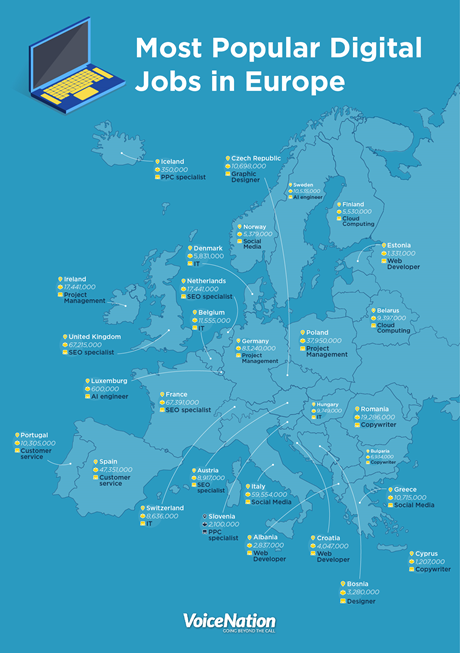
REVEALED: The most popular digital jobs in Europe by country

Are you a digital nomad wanting to visit another country, or an employee looking for a digital role? With the great resignation continuing into 2022, now is the time to think about a career change or a change of scenery – with new research showing which roles are most in demand.

The number of digital jobs has exploded in the past decade, with more than 3.3 million search results for ‘digital jobs Europe’ generated on Google in less than a second. In addition to this, Finland, Sweden, and Denmark topped the list of digitalization in 2020. In other words, employees are spoilt for choice.

Taking it upon themselves to find the most popular digital jobs per country, VoiceNation can reveal the countries where you are most likely to find an abundance of certain digital roles, from Web Developing and UX designers, to Digital PR Experts and Content Writers.

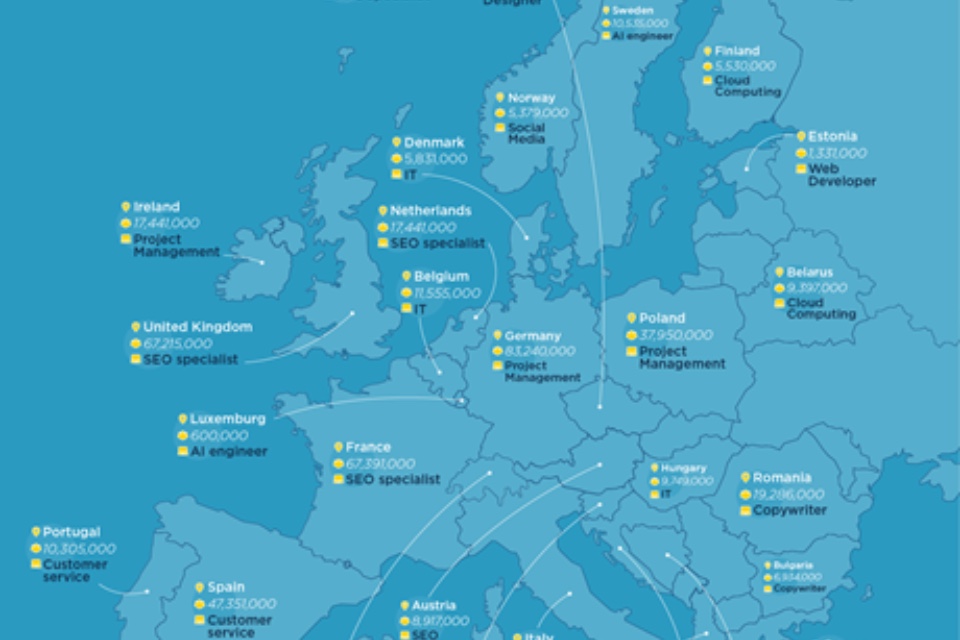
The most popular digital jobs based on the number of hiring ads online in every country are:

  • Germany – Project Management
  • France – SEO Specialist
  • Ireland – Project Management
  • UK – SEO Specialist
  • Belgium – IT
  • Greece – Social Media
  • Sweden – AI Engineering
  • Poland – Project Management
  • Italy – Social Media
  • Spain – Online Customer Service

Are you a creative thinker wanting a career in Social Media and are thinking about moving abroad? Italy and Greece are the countries with most social media roles available. There, you can both work and enjoy the sun.

If you are an SEO Specialist looking for the best places to work, the UK or France might be the countries for you. Out of all the digital roles available, there were most SEO Specialist roles available there. For aspiring project managers, look no further than Germany, the job beating SEO, I.T and Web Development.

Sweden turns out to be a hotspot for people looking for a role within AI Engineering. If you’re looking to soak in the sun while working, you don’t need to look far. Spain and Portugal are two of the best places to look for an online customer service role, with this digital job beating Web Development and SEO as the digital role companies are hiring the most for.

Building a cybersecurity strategy for marketers

By Radmila Blazheska, CMO, SecurityHQ and  Eleanor Barlow, Content Manager, SecurityHQ

Marketing teams often work with sensitive data, be it customer or contact data, in your CRM, WordPress site, payment details, and much more. Chief Marketing Officers (CMO’s), Head of Marketing, and Marketing Directors are accountable for data, how it is used, stored, and shared within their marketing teams.

Since GDPR was enforced, most marketeers also hold Data Officer roles, or are very interlinked with these roles, and form the connection between data, IT, and marketing departments. Which is why it is crucial for marketing teams to know how marketing tools are used, stored, and processed, so that if a data breach were to take place, accountability is made clear and next steps are known by all parties.

Three elements that marketing teams need to be especially prepared for are brand theft, supply chain attack/third party vulnerability, and data security weaknesses.

1.      Fight Against Brand Theft

Brand theft covers situations whereby any company/user, applies your company information, such as brand name, emails, domains, and elements like that, without permission/agreement. Copyright infringement included. Large companies are often targeted by phishing campaigns and there are also lots of fake social media accounts out there, right now, using y our brand. Which is why, if there is data that has already been stolen or breached, companies need to know about this, to know exactly what has been accessed, so that an action plan can be made.

Marketing teams need to be prepared if a breach is made, as most of the communication will fall onto the marketing team anyway. In turn, marketing teams need to know how to respond to a breach, how to communicate with customers following a breach, how to communicate with the public, with government enforcement, and more. On top of large fines, some brands never recover. Timing is everything, and bad PR can crush companies.

Marketing team individuals are also often targeted as they can easily be spoofed over an email or phone call. Identities of team members can be at risk, which is why Threat & Risk Intelligenceshould be used as a tool to view, monitor, prioritise and analyse all digital elements of your organisation. This includes internet, applications, systems, cloud, and hardware, to help detect and prevent attacks. By using this service, you will be alerted on any infringement both on the open and dark web.

2.      Know How to Spot Supply Chain Attack

An element impacting marketing teams, across the globe, are third party compromises and supply chain attacks. Every time there is a data breach of a third-party provider or data aggregator, there is also a data breach of all their users and partners. In response, a zero-trust model should always be implemented when working with a third party. But this is why it is very important that the marketing tools used by the marketing teams are secured.

Most marketers work with WordPress, or similar sites. If their site is attacked, how would they know? If they do not have the training, how would they know what to look for to stop an attack in the first place? When a data breach happens, there is also the question of how to communicate this to the customer base. Companies must legally declare a breach, but not all of them declare it to their customers, and if their data is misused then they are liable to pay substantial fines.

In effect, while basic training is usually presented to every employee, in every company, there is not much education for marketers on a more granular level. There should be more cyber training and awareness for teams, and marketing should work very closely with their IT Teams, data teams, and security teams, to ensure that the brand is protected, and marketing tools are armed against attack.

3.      Data Storage & Regulations

With GDPR, there is a fine-tuned process with regards to data storage, and how data is processed. There are also different legalities with regards to data, depending on geolocation. For instance, the EU has strict regulations, and now that the UK has left the EU, there are different regulations in place depending on where the data is coming from.

In addition, there are new regulations regarding cookies, which cannot be automatically stored anymore. This effects digital marketing and advertising, and marketers need to know how to deal with this sensitive information now that laws and regulations have changed.

How Marketing Teams Can Move Forward

In every company, in any industry, marketing teams should have access to Threat & Risk Intelligence (TRI) and they should have more advanced and regular cyber awareness training.

On top of this, security teams should have in place Vulnerability Management to view and act on all vulnerabilities across all your digital platforms. As well as Endpoint Protection, to safeguard both personal and business devices as teams work remotely.

The accountability and liability of data storage should be ingrained in marketing roles. Because, sometimes, our greatest threats are ourselves. Therefore, Cyber Marketing Awareness and training is a must for all marketers, and marketing teams should work with (and alongside) IT and data teams, to make sure that all their data and marketing tools are protected against cyber threats.

Do you specialise in Brand Monitoring? We want to hear from you!

Each month on Digital Marketing Briefing we’re shining the spotlight on different parts of the print and marketing sectors – and in June we’ll be focussing on Brand Monitoring solutions. It’s all part of our ‘Recommended’ editorial feature, designed to help marketing industry professionals find the best products and services available today. So, if you specialise in Brand Monitoring and would like to be included as part of this exciting new shop window, we’d love to hear from you – for more info, contact Clair Wyld on c.wyld@forumevents.co.uk. Here’s our features list in full:- Jun – Brand Monitoring July – Web Analytics Aug – Conversion Rate Optimisation Sept – Digital Signage Oct – Brochure Printing Nov – Creative & Design Dec – Online Strategy

Smarter Payments Summit: Find out what’s new in 2022

As a marketing or e-commerce professional there’s a free pass waiting for you at the Smarter Payments Summit, which is taking place on September 7th at the Hilton London Canary Wharf.

The Smarter Payments Summit‘s fully complimentary pass includes;

– A personalised “corporate speed-dating” itinerary of short meetings with innovative and budget-saving suppliers, that can support your current and upcoming projects (No hard sell).
– Access to our insightful and educational seminar sessions
– Lunch and refreshments throughout

Plus, you can network with fellow payment professionals that share your daily challenges, including those from; Amazon UK, Boots UK, IKEA (Ingka Procurement), Rated People Limited, Reach PLC and many more.

Click here to secure your free place, or get in touch with us here.

Research reveals Gen Z avoids ads at all costs

Any company looking to target Gen Z consumers (those born between 1997 and 2012) shouldn’t even bother with traditional advertising.

That’s the stark finding from a new report released by digital consumer research firm Bulbshare, which gathers insights from thousands of consumers around the world.

Titled Ad blockers and advocacy: Why Gen Z is blocking paid ads in favour of real voices, the report finds that 99% of consumers in this generational cohort will hit “skip” on an ad if it’s an option and that nearly two-thirds (63%) use ad blockers to avoid online adverts.

Their readiness to do so comes largely from the fact that they feel overwhelmed by the number of adverts they see daily. The report shows that nearly three-quarters (74%) of consumers feel bombarded with ads. The same percentage feel irritated with adverts and the incursions they place on their time. One in four, meanwhile, find advertising extremely intrusive, while one in two believe it is somewhat disruptive.

“The best advertising has always been disruptive,” says Bulbshare founder and CEO Matt Hay. “It should be difficult to ignore. But today’s brands face the very real danger of being part of an indistinct but annoying wall of noise”.

Over the past decade or so, brands have increasingly supplemented their traditional advertising efforts with influencer marketing. But customers are becoming more distrustful of the relationships between big brands and high-profile figures.

Bulbshare’s research shows that 84% of Gen Z consumers have lost faith in influencers. They are, unsurprisingly, more inclined to make purchases based on authentic recommendations. In fact, 86% would be more inclined to buy a product recommended by a friend than a paid influencer.

“This desire for authenticity makes it imperative that brands not only have products worth recommending but that they cultivate communities where authentic recommendations can take place,” says Hay. “In fact, there’s real hunger for this among Gen Z consumers. Some three quarters (74%) would promote a product they genuinely care about online. Moreover, 88% are enthusiastic about collaborating with brands, and 76% said they enjoy reviewing products.”

“In a world where 81% of consumers trust real opinions over those promoted via an advert,” Hay concludes. “It makes much more sense to allow consumers to be authentic advocates for a product or brand than to spend money on an ad that will, at best, be ignored and cause active resentment at worst.”

Download Ad blockers and advocacy: Why Gen Z is blocking paid ads in favour of real voices here.

Junior marketers ‘driving customer experience innovation’

Junior marketers are playing a leading role in driving innovation, with 50% saying that trying out new techniques and ideas to improve customer experiences is a major part of their day-to-day activities.

That’s according to Optimizely’s Culture of Experimentation report, based on a survey of 200 UK in-house marketing executives, assistants and managers, which also highlights that 50% of marketing assistants are directly responsible for improving the customer experience, compared to 42% of marketers at management level.

The report reveals junior team members are being entrusted with driving innovation and change to improve customer satisfaction, with only 14% saying they don’t have the freedom to try new things and 24% that their opinion isn’t valued by senior team members.

Commenting on the findings, Kirsten Allegri Williams, CMO of Optimizely, said: “It’s very encouraging to see that so many junior marketers in the UK are being inspired to challenge established marketing practices. Experimentation is integral to the customer experience, so introducing this mindset and challenging the status quo can significantly impact how brands interact with their audiences in a positive way.

“Junior marketers are the ones who are likely to shape the future of UK marketing. Bringing this experimentation practice will absolutely help to advance their careers, along with their enthusiasm and a fresh thinking. It’s vital that senior team members embrace this and drive collaboration at all levels, making everyone feel heard so new data-based changes are implemented wherever possible.”

The B2B alternative to influencer marketing

Jamie Barlow, managing director of Hyped Marketing, discusses the effectiveness of influencer marketing…

If you’ve ever taken out a traditional print or TV ad, you’ll know how pricey they can be.

Unfortunately, ramped up costs don’t always equal effectiveness. And traditional ads don’t always offer the best return on investment. As such, many businesses are turning to influencer marketing.

But what is influencer marketing exactly?

On a basic level, it’s a type of social media marketing that uses endorsements from “influencers”, who are viewed as experts in their field. Think of it a little bit like PR. Only, instead of getting exposure from publications, you’re getting it through individuals and their social channels.

Why is influencer marketing effective?

Influencer marketing works because of one crucial thing: trust. Think about it — how much do you trust messages from a business compared to those from your friends or colleagues? Or reviews on a company website compared to those from other customers on Google?

Over time, influencers have built up a loyal following of people, who hang on their every word, actively engage with them and trust that the recommendations they make are genuine. So, if you can get these individuals to spread your message, you’ll massively boost persuasiveness.

Plus, since influencers operate independently and create their own content, they are in control of how they portray your message (within reason). This promotes authenticity and can help you reach a specific target audience.

The rise of B2B influencer marketing

When it comes to influencer marketing, there’s no denying that B2B companies were late to the game. While B2C brands were establishing relationships with influencers, the B2B world was only just discovering social media.

Even now, the likes of Instagram and YouTube are dominated by bikini-clad influencers pushing the latest superfood products to consumers. (Hey, we only said they were viewed as experts — not that they necessarily are!)

But the reality is, influencer marketing is far more important for B2B than B2C. After all, the average purchase prices in B2B completely dwarf those in B2C. People are also less likely to gamble on purchasing B2B products and services as they would with consumer goods. So, word-of-mouth and influencer marketing are essential to drive leads and sales.

How to get into influencer marketing

First and foremost, you need to forget all about going after those big influencer names. They’re out of reach (and way out of budget for SMEs). Plus, people are starting to see through these mega-influencers.

Nothing compromises credibility faster than a tone-deaf endorsement from a high-profile influencer, who everyone knows was paid thousands for a single social post. Instead, you need to be exploring a more niche influencer marketing strategy — looking at respected speakers, authors, podcasters and commentators in your industry.

For one, a micro-influencer will also be a lot easier on your marketing budget. Secondly, even though these micro-influencers have much smaller audiences, their followers will invariably be far more engaged and switched on to what they have to say. Together, this means your cost per post engagement will be much lower.

It’s also worth pointing out that you’ve probably got a whole bunch of potential influencers sitting right next to you — your employees or colleagues! Collectively, your employees and co-workers will have far more connections than your company and appear much more authentic. So, you should never underestimate the value of employee advocacy and influence.

Encouraging employees to share relevant industry and company-related content is a great way to engage this often-overlooked resource. LinkedIn is a fantastic platform for sharing though-led articles and company posts via employees. In fact, employee re-shares of company-posted content often have more than double the click-through rate of the original post!

And a final piece of advice — don’t expect to see results overnight. B2B purchases involve multiple decision-makers, meaning it will often take much longer for the impact of influencer marketing to reach all these people.