Digital Marketing Solutions Summit | Forum Events Digital Marketing Solutions Summit | Forum Events Digital Marketing Solutions Summit | Forum Events Digital Marketing Solutions Summit | Forum Events Digital Marketing Solutions Summit | Forum Events

Posts By :

Stuart O'Brien

Digital Customer Engagement Summit – Just a month to go!

Don’t miss out on your complimentary delegate place at the Digital Customer Engagement Summit, which takes place in London on November 24th.

The Summit is unaffected by the recent government announcements, but we wanted to update you about the guidelines that we have put in place at the event;

– Plenty of space as the venue be running at 50% capacity

– Registration will be staggered ensuring no long queues – Your temperature will be taken at arrival

– Face masks must be worn at all times, unless exempt or seated

– The event will be as paper free as possible – your itinerary will be sent to you via email

– Sanitation stations will be dotted around the venue for you to use

– Meeting booths will be spaced out (in line with the current social distance measures) and will consist of a table and two chairs with a protective screen

– There will be a one way system in place, which will be pointed out with arrows on the floor

– All meals and refreshment will follow the government guidelines –  creating a relaxed and fun atmosphere. Please note, we have Flexible attendance options – for duration and also the ability to switch to VIRTUAL attendance at any given time.

We look forward to seeing you on the 24th November at Hilton London Canary Wharf.

Click here to register.

Or if you have any questions then you can contact Haley Stratton at h.stratton@forumevents.co.uk.

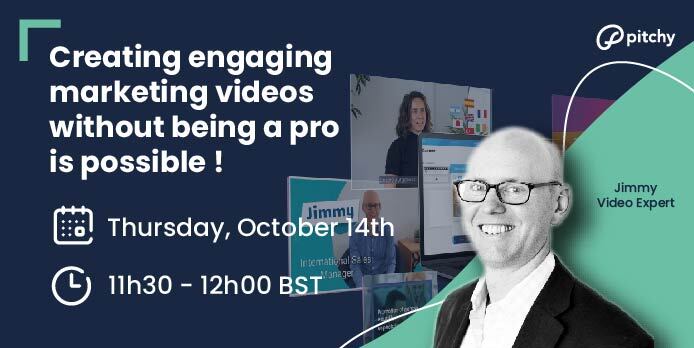
WEBINAR: Video for your business made easy

Pitchy is a video-editing solution that enables you to create professional videos without any skills on your own. Access a demonstration of the solution by registering for our free webinar on Thursday 14th October at 11:30am.

Register for free!

THURSDAY, OCTOBER 14th | 11:30 AM (BST)

✔ Editing and video styling

✔ 1200+ motion design animations

✔ All types of videos (presentations, interviews, tutorials, social media…)

✔ All types of formats (landscape, portrait and square for social media)

✔ Access to 1M+ of royaltee-free media (pictures, videos, icons, music…)

✔ Automatic subtitling and translation in 50+ languages

✔ Voice over and the text-to-speech features

✔ And much more!

Register for free!

Pitchy is a SaaS online video editing solution, that allows professionals to create their corporate videos in a completely autonomous and personalised way.

“What we really liked about Pitchy was the concept […] that allows us to be free, autonomous, to be able to make the amount of videos we wanted, at a completely controlled cost.” – Emmanuelle Leduc, Head of Project Contributions and Deployment at BNP Paribas

“This tool was popular among the departments because it was easy to use, enabling everyone to produce professional quality videos independently without having prior video editing skills.” – Alexandre Guerfal, Deputy Head of department DECADE IGPDE

Half of consumers ‘will dump brands’ if they can’t log in

The majority of consumers (56%) have ditched a digital account or online service when logging in was ‘too frustrating’, with 77% having abandoned or stopped creating an online account for a variety of reasons, including being asked to provide too much personal information (40%), needing too much time to enter info (33%), and too many security steps (29%).

That’s according to a new survey from Ping Identity, Brand Loyalty Is Earned at Login, which shows that while consumers are interested in securing their online accounts four in 10 (39%) are unwilling to spend even 2 minutes adjusting privacy settings.

The news comes as Microsoft announced that users will be able to log in with biometric scanning instead of traditional passwords, in a bid to safeguard digital identities and make the user experience more convenient.

Key findings include:-

Consumers demand easy, fast experiences

  • 77% have abandoned or stopped creating an online account for a variety of reasons, including being asked to provide too much personal information (40%), needing too much time to enter info (33%), and too many security steps (29%).
  • 56% have abandoned an online service when logging in was too frustrating.
  • 63% are likely to leave an online service for a competitor who makes it significantly easier to authenticate identity.

As passwords get worse, passwordless looks even better

  • 58% are comfortable with the concept of a digital ID capability that stores personal information securely on a smartphone to share electronically.
  • 46% would prefer to use a service or site that offers an alternative to passwords.
  • 44% admit to weak password practices, including making a minor change to an old password (29%) or reusing a password from another account (15%.)

Privacy should be transparent and simple

  • 85% are interested in learning how online services share their personal information, but 72% say that information is difficult to find.
  • 72% have manually adjusted their profile settings to control privacy—including a massive 89% of Gen Z.
  • 60% have dropped an account over privacy concerns, including 46% who have done so more than once.

“With more options than ever before, businesses now need to integrate their security, privacy and user experience strategies to keep up with modern consumer expectations,” said Richard Bird, chief customer information officer, Ping Identity. “Individuals have no hesitations about finding better experiences elsewhere, so companies that prioritise customer experience now will earn loyalty in the long run.”

The Ping Identity Consumer Survey: Brand Loyalty Is Earned at Login asked more than 3,400 consumers across the US, UK, Germany, France and Australia about their typical registration and login experiences, attitudes toward online privacy and willingness to share personal information.


Do you specialise in Brochure Printing? We want to hear from you!

Each month on Digital Marketing Briefing we’re shining the spotlight on different parts of the print and marketing sectors – and in October we’ll be focussing on Brochure Printing solutions. It’s all part of our ‘Recommended’ editorial feature, designed to help marketing industry professionals find the best products and services available today. So, if you specialise in Brochure Printing solutions and would like to be included as part of this exciting new shop window, we’d love to hear from you – for more info, contact Clair Wyld on c.wyld@forumevents.co.uk. Here are the areas we’ll be covering, month by month: Oct- Brochure Printing Nov – Creative & Design Dec – Online Strategy

Global digital ticketing transactions will exceed 33bn in 2023

A new study from Juniper Research has found that global digital ticketing transaction volumes will exceed 33.8 billion in 2023, from 20.8 billion in 2021; surpassing pre-COVID levels for the first time.

The research found that this 62% growth will be driven by a resurgence in travel, as well as the recovery in events ticketing.

The research predicts that, while consumer concerns around safety in the post-pandemic environment will persist, adopting digital ticketing solutions, which limit contact and provide information on congestion, can alleviate these concerns. It found that this appeal will lead to a more digital recovery in ticketing; providing a significant opportunity for digital ticketing vendors.

The Digital Ticketing: Industry Trends, Competitor Leaderboard and Market Forecasts 2021-2026 report found that metro and bus ticketing will account for over 33% of digital ticketing transaction volume in 2023; making it the biggest segment, compared with rail, airline and events ticketing. The report identified the high average number of trips in this segment; making it an ideal option for digital ticketing disruption. While average ticket value in this segment is low, it will seed greater digital use in other segments; driving the whole market forward.

The research also found that contactless ticketing is thriving in the pandemic recovery, with over 23% of global digital ticketing transaction volume in 2026 being via this method, compared to only 10% pre-pandemic in 2019. As many transit operators expanded their contactless roll-outs mid-pandemic, this has accelerated digital ticketing adoption. The report predicts that as contactless payments accelerate via a permanent shift in consumer behaviour post-pandemic, this will be reflected in the ticketing space, with transit increasingly dominated by contactless ticketing.

Research co-author Harry Crabtree said: “As travellers get used to digital ticketing within metro and bus, this provides the opportunity to disrupt further areas, as user familiarity grows. This will allow ticketing vendors to target more lucrative segments.”

Digital agencies struggling to find the right skills

67% of agencies have hired during the pandemic – but 51% have struggled to find employees with the skills they need,  52% said that they have struggled to find contractors with the skills they need and 39% are concerned about a skills gap in the industry.

That’s according to Verblio’s annual digital agency survey, provides insight into the industry during the past year, including content creation during Covid-19, the secrets of content success and hiring, skills and the most popular tools.

Other key findings include:

  • SEO is the most desirable skill in the industry

  • Demand for content increased by 71%

  • Asana is the top tool for content success in the industry

  • 18% of marketers admit to buying links

  • Agencies gained an average of 9 clients and lost fewer than 4 over the past year

  • 75% expect continued growth into 2021 and beyond

  • Blog posts (61%), landing pages (42%) and social media posts (35%) are the most profitable content types

  • Social media posts (79%), email newsletters (65%) and outreach (27%) are the most popular promotion tactics

  • Blog posts (61%), landing pages (47%) and video (43%) are the best content to invest in

The most desirable marketing skills

The survey revealed that the most desirable marketing skill is SEO and SEM, with creative thinking and ideation, and copywriting coming in second and third.

Rank

Marketing Skills

Percentage Vote

1

SEO and SEM

71%

2

Creative thinking and ideation

65%

3

Copywriting

58%

4

Data analysis

42%

5

Social media

27%

5

Paid social media advertising

27%

6

Sales

26%

7

Developer

24%

8

Design

23%

9

Email marketing

22%

10

CRM

10%

11

Mobile marketing

8%

11

Digital PR

8%

Despite the pandemic, the vast majority of those surveyed said their agency had actually seen an increase in business over the last 12 months, with 71% agreeing that demand for content specifically had grown.

During the last year, on average, agencies have gained over nine new clients and lost less than four.

A whopping 75% of those surveyed expect revenue generated from content to increase over the next year, with just 3% believing it would decrease.

Verblio found that on average, agencies charge over $2,000 for an interactive campaign and more than a quarter charge $5000+. Unsurprisingly, social media posts are the cheapest content type with an average price of $130.

Despite interactive campaigns commanding the highest price, blogs take the top spot for generating profit, with 62% selecting blogs as one of their most profitable content offerings. Landing pages come second, with 42% saying they are a leading profit maker for their business.

Nearly all the experts Verblio spoke to agree that some form of promotion is needed to get results. Promoting via the client’s social media is the most popular method at 79%, but 18% of agencies still admit to buying links and coverage.

The survey asked experts what content offerings they plan to invest in the most over the next five years and blogs take the crown. Over 61% of content creators are looking to expand and develop their blog offering, with landing pages and video not far behind.

Top 10 tools for success

29% of agencies don’t rely on any particular tools. The other 71%, however, have plenty they can’t live without. Here are the top 10 tools for digital marketing success.

  1. asana

  2. Monday.com

  3. Hotjar

  4. SEMRush

  5. crazyegg

  6. Trello

  7. 99designs

  8. ahrefs

  9. Lucky orange

  10. accelo

Touching on the survey insights, Verblio CEO Steve Pockross, said “The results from the 2021 digital agency survey show that despite a crazy year like 2020, agencies continue to see the value in content marketing,with demand for the service increasing by 71%. It’s encouraging to learn that 67% hired during the pandemic, with SEO coming in as the most desirable skill. But with 51% struggling to find the right people for the job and 39% concerned about a skills gap, it’s clear more needs to be done to upskill teams and attract more talented individuals to the industry.”

Kids speak to Alexa more than to their own grandparents

Generation Alpha, those children born after 2010, speak to their smart speakers, such as Alexa, Siri and Google Nest, more than their own grandparents.

That’s according to research from global cloud communications platform Infobip, commissioned with global public opinion firm YouGov, which polled British children aged 6–11 years old.

The survey aimed to assess the impact technology is having on how children see and interact with the world around them. Results reveal a quarter (25%) of Generation Alpha with smart devices speak to Alexa and other smart speakers every day. Yet only one in ten (11%) speak to their grandad and just 14% speak to their grandma daily.

Other key daily habits of this youngest category of the generations include:

–          Nearly half (46%) have an active social media account, despite Facebook, TikTok and Instagram insisting on a minimum age of 13 for account holders;

–          Three-fifths (61%) who have access to a tablet have their own device, compared to a third (33%) who use a family device;

–          Half (49%) of respondents have their own smart phone, while a further two-fifths (43%) use a smart phone belonging to a family member;

–          Three in ten (30%) of those surveyed are liking, swiping and texting on their smartphones for more than an hour a day.

The research also discovered that two-thirds (66%) of Generation Alpha children started using tablets such as iPads before the age of five and under. Two-fifths (41%) say they have been speaking to smart speakers from the age of 6 or younger, and, incredibly, a third (34%) claim to have first started using iPads before even reaching their fourth birthday.

In terms of most popular ways to stay in touch, over a third of 6-11 year olds surveyed are on WhatsApp – with a whopping 73% of 11 year olds well-versed in this channel. SMS isn’t far behind, with a third (29%) of Generation Alpha still using this more traditional texting method and a third (33%) using Facetime.

Catherine Thevenot, Professor in Cognitive Developmental Psychology at the University of Lausanne, said: “Whether in Preston or Paris, Lausanne or London, the children of Generation Alpha rely on digital tools to learn and play, which influences the way they develop and see the world around them. From the age of just 18 months, children can understand the difference between a robot and a human: they recognise that only humans have a conscious goal, but the fact remains that they are interacting more with their smartphones and tablets than with some of their own family members. While the impetus is on the adults in their lives to guide them to use digital tools in the most positive and safe way possible – both in the home and the classroom – brands and influencers should also consider how they can curate digital experiences that will enrich this future generation as potential employees and active citizens. It’s about striking the right balance between virtual and real-life activities”

Nikhil Shoorji, Managing Director Europe at Infobip, said: “For all the talk about Millennials and Generation Z, it is Generation Alpha who have been surrounded by technology since the moment they were born: the first truly digitally-immersed humans. In the same way that they develop everyday relationships with family members, this group has grown accustomed to interacting with technology on demand from a very early age.”

Global digital advertising market to hit $179.77bn in 2021

The global digital advertising market size 2020 was $155.53 billion and it is expected to grow to $179.77 billion this year at a compound annual growth rate (CAGR) of 15.6%.

That’s according to a new report from The Business Research Company, which says the growth is mainly due to the companies rearranging their operations and recovering from the COVID-19 impact, which had earlier led to restrictive containment measures involving social distancing, remote working, and the closure of commercial activities that resulted in operational challenges.

The market is expected to reach $281.32 billion in 2025 at a CAGR of 11.8%.

Along with interactions in the ads themselves, the report says digital advertising companies are increasingly adopting conversational interfaces or chat box to increase speed and productivity while dealing with common consumer issues.

End users of financial institutions have become extremely reliant on conversational interfaces to provide 24/7 service, instant responses to queries, and quick complaint resolution for providing answers to queries effectively. Conversational interfaces also provide an easy and economical way for organisations in different sectors to receive customer feedback.

The report cites companies such as Starbucks, which are increasingly adopting conversational chat box to allow users to order through its MyBarista application via auditory message, which works faster than the traditional methods.

It says the global digital advertising market is highly saturated, with small number of large players. The top ten competitors in the market made up to 64.53% of the total market in 2020. Major players in the market include Google Ads, Facebook, Alibaba, Amazon, Tencent, Baidu, Microsoft, Verizon, Twitter, and Sina Weibo.

North America accounts for the largest digital advertising market share 2021, having had 32.0% of the total in 2020. It was followed by Asia Pacific, Western Europe and then the other regions. Going forward, according to TBRC digital marketing industry growth statistics, the fastest-growing regions in the digital advertising market will be the Africa and the Middle East, where growth will be at CAGRs of 18.4% and 16.7% respectively during 2020-2025. These will be followed by South America and Eastern Europe, where the markets are expected to grow at CAGRs of 16.7% and 16.6% respectively.

60% of CEOs believe that the marketing potential of LinkedIn is exaggerated

60% of CEOs whose businesses have advertised on LinkedIn believe that the social platform’s marketing potential has been exaggerated.

That’s according to the latest research from behavioural targeting company Bango, which surveyed over 200 CEOs, found that over three-quarters (77%) of CEO’s would not endorse any future spend on LinkedIn advertising. But the skepticism doesn’t end with LinkedIn, a further 52% refuse to endorse increased Facebook spend, while 66% decline budget allocation for Twitter advertising.

According to those surveyed, social media has limited use — with 59% believing it to be good for building up reputations, but not for specific business goals like generating sales. With CEO’s being primarily concerned with investments that directly contribute to their bottom line, it comes as no surprise that 22% of CEOs cite social media marketing spend as the very first thing they would reduce in the event of a budget cut.

These latest figures are part of Bango’s ongoing Board to Death campaign, which highlights just how little digital ad spend can be directly tied to business results like sales and revenue.

Anil Malhotra, CMO at Bango and co-author of the research, said: “With 3.78 billion social media users worldwide spending almost 2.5 hours every day scrolling through their preferred social channels, it’s no wonder that marketers want to devote ad spend there. However, tempting though it is, targeting prospective customers through social media isn’t delivering the hard business results that CEOs are looking for.

“The nature of social media advertising is to target people based on what they follow, like, share and comment on — which is a very poor measure of what people are actually willing to spend money on. Subsequently, countless dollars are wasted on ads which never reach real prospective buyers.”

‘Purchase Behavior Targeting’ is the method Bango proposes to bridge the disconnect between advertising and sales. Originally introduced by Facebook, this technology allows digital marketers to target social media campaigns based on what users have previously bought. According to Bango, this technology is the marketers’ best bet for tying social media back to sales, rendering channels like LinkedIn more effective for businesses.

Bango’s interactive research report can be found at https://bango.com/board-to-death/

SMS best practices to ensure success

By David Greenberg, CMO, Act-On

SMS is a very powerful channel to deliver better experiences and improve customer lifetime values, but many marketers have yet to explore its full potential. SMS can often be overlooked by brands who can be wary of reaching customers on their most personal devices.

However, 90% of consumers prefer SMS to a phone call and 75% want to receive special offers on their phone, according to SMS Comparison figures. That is why average SMS click-through rates are riding high at 19%, compared to just 4% for email.

This customer expectation, that brands will build a rapport and keep a conversation going over text, means automated SMS should be a central part of any marketer’s strategy to nurture and retain customers, so long as it is permission-based and used wisely.

This customer expectation, that a brand will keep a conversation going via text, is a golden opportunity for marketers to deliver on their wider strategy of improving the lifetime value of customers by offering better experiences. This is a real sweet spot for automated SMS which improves both brand and product engagement.

The customer expectation is already there, they just need more marketers to catch up as policy is such a crucial element of brand experience in today’s world. For customers who have opted in to receive text messages, a brand can use its marketing automation platform to deliver useful information. Strategies have to focus on what the customer will want to know, such as event details, purchase confirmations, delivery updates and loyalty point balances, to name just a few. The smartphone is the perfect place for these messages to land because, unlike email, people are permanently on their mobile phones, meaning the average text message is read and responded to within just three minutes.

Automated campaigns can deliver these updates where and whenever they are needed at low cost but they must be set up with a fanatical focus on helping customers as part of a company’s strategy to engage, nurture and retain. Get it right and analytics suggest SMS open rates can exceed 95% and click-through rates will reach as high as 40%.

So, what are the might high-value use cases to start with automated SMS? Typically, these include:

  • Confirmation of purchase and payment is taken, followed by delivery updates
  • Links to further information about getting the most from a product or service
  • Feedback surveys
  • Promotions, flash sales and coupons personalised to each customer’s purchase history
  • Notifications and reminders of events – such as a product demonstration or check-in time
  • Reminders – when does my parking run out, when do those theatre tickets go on sale
  • Time-saving tips, confirmation of meeting locations with directions

Ensuring you deliver value through SMS outreach

The elephant in the room with SMS is that some customers may have had a bad experience in the past through spam texting, which makes it critical for marketers to guard their brand by ensuring campaigns are opt-in driven. However, the evidence now points to consumers both accepting and expecting responsible text messaging from reputable businesses. It is the approach that matters here and so the guiding philosophy should always be respect – only message customers when you are delivering value and always ask for permission first.

This is why automated SMS must never be seen in isolation, but rather as a highly effective tool deployed by teams seeking growth opportunities across multiple channels.

To avoid running the risk of frustrating customers, here are some simple best practice tips to bear in mind:

  • Secure fully informed consent (it’s both best practice and a legal requirement) – opting for a platform that has best practice built-in to how it operates can simplify this process
  • Openly share confirmation of SMS enrolment, data policies and opt-out options
  • Never schedule B2B messages out of office hours
  • Set customer actions that are best supported by SMS
  • Pre-set frequency caps to avoid frustrating customers – the use of tools can support this
  • Keep volumes and frequency low to start, then build up gradually

Experiment to drive growth

As with any growth marketing tactic, teams should feel free to experiment with messaging and the timing of communications, as well as frequency caps, to get a better hook on what works best. Using A/B testing is a good idea here, as is paying close attention to analytics provided by your automated SMS supplier. Figures for response rates and opt-outs are key numbers to watch early on in your SME journey.

As marketers engage more and more with automated SMS outreach, it must be kept front of mind that they are reaching out to consumers on their most personal device. Respect for privacy and transparency are fundamental requirements that should lead all marketers to only reach out to customers when they are truly delivering value.

Get it right, and marketers will find SMS is a central part of their automated marketing strategy because, as long as it is run on an opt-in basis, it allows them to build personal relationships with customers or potential customers. By ensuring an SMS is truly helpful and provides consumers with the content or information they want, marketers can maintain a two-way conversation that delivers on the wider strategy of delivering higher lifetime value for customers.