Digital Marketing Solutions Summit | Forum Events Digital Marketing Solutions Summit | Forum Events Digital Marketing Solutions Summit | Forum Events Digital Marketing Solutions Summit | Forum Events Digital Marketing Solutions Summit | Forum Events

All

Grow like a Badass Unicorn at Digital Marketing Solutions Summit

Not yet registered for the Digital Marketing Solutions Summit? This unmissable event takes place May 13th at the Hilton London Canary Wharf.

The Summit allows you to connect with innovative and budget-saving suppliers, as well as learn about the latest insights within the eCommerce industry.

Your pass is entirely free and includes access to insightful webinars including “Grow like a Badass Unicorn“, in which Alice ter Haar, Founder & Chief Unicorn, Badass Unicorn, will teach you how to apply the growth strategies of the world’s most inspiring businesses.

This session is a whistle-stop self-awareness and self-empowerment tour where you’ll reconnect with the most important ingredient for personal and professional success – yourself.

The output? The self-awareness and motivation to take your potential by the (unicorn) horn by being your most badass self.

Confirm your place here via our online booking form – attendance options are flexible.

Do you specialise in Lead Generation & Tracking? We want to hear from you!

Each month on Digital Marketing Briefing we’re shining the spotlight on different parts of the print and marketing sectors – and in February we’ll be focussing on Lead Generation & Tracking services.

It’s all part of our ‘Recommended’ editorial feature, designed to help marketing industry professionals find the best products and services available today.

So, if you specialise in Lead Generation & Tracking solutions and would like to be included as part of this exciting new shop window, we’d love to hear from you – for more info, contact James Howe on j.howe@forumevents.co.uk.

Here are the areas we’ll be covering, month by month:

Feb – Lead Generation & Tracking
Mar – Email Marketing
Apr – Digital Printing
May – Social Media
Jun – Brand Monitoring
Jul -Web Analytics
Aug -Conversion Rate Optimisation
Sep -Digital Signage
Oct -Brochure Printing
Nov – Creative & Design
Dec – Online Strategy

UK entertainment sales driven to new highs by lockdown streaming

Locked down Britain turned to digital music, video and games in record numbers in 2020, increasing entertainment revenues by 16.8% to a record £9.05bn, according to preliminary data compiled by the Entertainment Retailers Association (ERA).   

It was the fastest growth rate since records began, driven above all by digital services, who saw revenues increase by £1.4bn over 2019 to a new high of £7.8bn. 

Digital video services spearheaded by Netflix, Disney+ and Amazon Prime Video increased revenues by a remarkable 37.7% over 2019 while growing music streaming subscriptions saw recorded music revenues score their best result since 2006.

Gaming comfortably retained its lead as the largest of the three sectors, generating sales of more than £4bn for the first time.

Overall more than 80 pence in the pound spent on entertainment now goes to digital services rather than physical formats. Amid generally declining physical formats, vinyl LPs remain the shining exception, increasing sales by 13.3%. 

ERA CEO Kim Bayley said, “If there was ever a year in which we needed entertainment, it was 2020. The trend towards an increasingly digital entertainment market may be long established, but no one could have foreseen this dramatic leap as digital services filled the gap left by shuttered cinemas, concert halls and retail stores. With much of the country shut down, ERA’s members provided a welcome revenue stream for thousands of musicians, actors, directors and countless backroom staff.”

UK Consumers’ Favourite Brands revealed – And Amazon is top

The DMA has revealed the findings of its latest ‘How to win Trust and Loyalty’ research, which set out to gauge which brands UK consumers are most loyal towards.

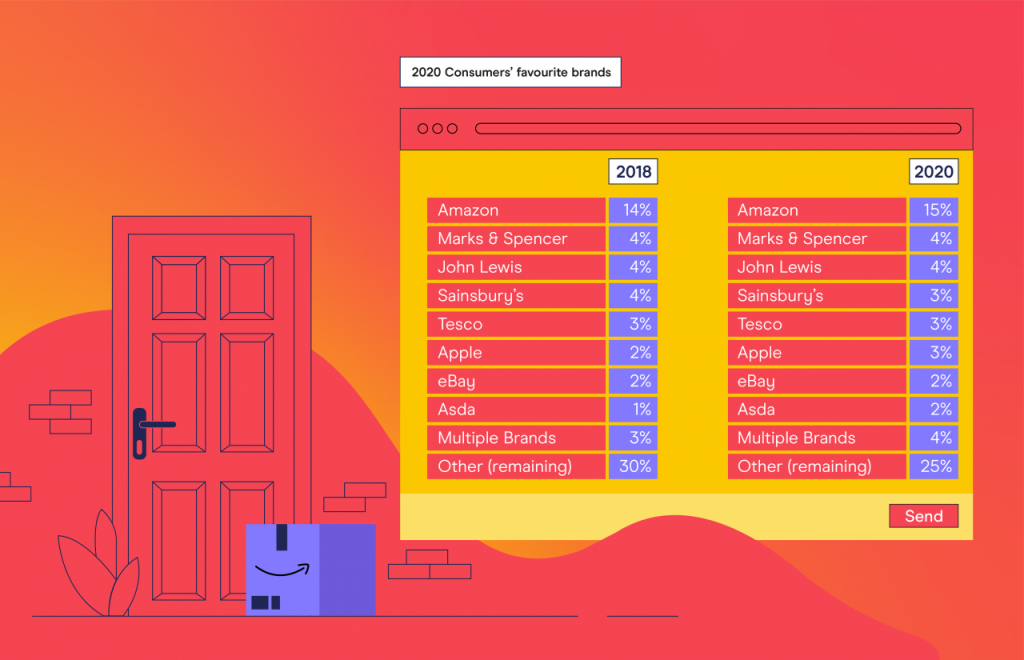
Amazon turned out to be the most mentioned brand, with 15% of consumers naming it, followed by John Lewis (4%), Sainsbury’s (4%), and Tesco (3%).

When the DMA asked the same question back in 2018, the top choices looked very similar. Indeed, consumers mentioned Amazon (14%) followed by equal percentages selecting Marks & Spencer (4%), John Lewis (4%) and Sainsbury’s (4%).

Somewhat surprisingly, despite Amazon’s near-ubiquity across so many areas of consumption, the brand hasn’t gained any further traction with customers over the last 2 years.

The DMA says that, hypothetically, a reason behind such consistency can be explained by consumers’ view of Amazon more as a service provider rather than a brand to engage with. Data also reveals consumers’ loyalty to Amazon as being driven by convenience (54%) rather than a genuine connection (46%).

When consumers were asked to tell us their favourite brands, a quarter (25%) mentioned other brands outside the top ten, highlighting the variety of businesses that have managed to conquer consumers’ loyalty and that big brands are not as dominant as we might expect.

Data also revealed that about a third of consumers (35%) report not feeling loyal enough to any brand to name it as their favourite. This group’s voice is a clear testimony of the daily challenge brands must deal with: connecting with customers, gaining their trust, and being thought of when it’s time to purchase.

The DMA also dug further into why these consumers do not feel a sense of loyalty towards any brand. Consumers offered a range of reasons, from simply not feeling strongly about brands to wanting to try new ones.

The good news is that two out of the three reasons given are barriers that brands should be able to overcome themselves, with the right strategies.

Indeed, reward mechanisms for continued loyalty, such as wider benefits and offers, can be revisited to give consumers relevant value. Furthermore, the DMA says innovation and communication about improvements can be used to attract those who seek change and novelty. 

Read the full report here. 

Tips for successful customer journey mapping

By Leanne Coker, Service Design Lead at dxw 

Approach mapping in the same way you would any other design task – by starting with user needs and testing it.  Recognise that the formats we’re used to as designers (blueprints, journey maps, and the like) are not always familiar to the intended audience and in fact may not align with their mental model.

Make time at the start to think about who the map is really for – is it for the team, internal stakeholders, external stakeholders? It’s probably likely to be a combination. Think about their needs and accommodate them. Create different versions if you need to.

Before you’ve invested too much time in creating a work of art, test your idea with different audience members. It might be a blank or partially complete template but there are still valuable things to learn by showing it to people. Ask if it makes sense to them? Can they work with the format? This will save time reworking things down the line and help make the map more effective.

Don’t feel constrained by templates and prescriptive formats

There are standard map formats and templates, and they are really helpful. They prompt us to think about the right things, save time, and overcome blank sheet paralysis. However, there are some pitfalls to watch out for.

For example, a project brief might ask for a customer journey map or service blueprint because it’s the done thing. But without a clearly understood purpose and audience it might not add value. Other traps to avoid are letting our thinking become constrained by the boxes and lines on a map template or getting bogged down trying to populate all the sections with detail that’s not useful.

We might start with a template but then tweak the structure to fit our particular needs right now. Sometimes we may only be interested in certain rows from that blueprint, or we might want to create a hybrid map that’s a user journey/service map mashup. We might want to create something totally new and that’s okay too. Freestyle mapping can land us at the most elegant and impactful result.

The mapping process is as important as the outcome

Co-creating maps with the team or wider stakeholders can be a great way to gather information and generate a shared understanding. It also supports collaboration and effective decision making. But it’s not always best done in this way and the decision to co-create or not will depend on why you’re producing the map as well as access to information, people, and time.

If you’re creating a map on your own, the process can still be a learning experience. It helps us organise and synthesise our own thoughts. It will generate important questions and discussions. Make sure you don’t lose them. Write them down and follow them up.

Get comfortable with imperfection

A map is only ever going to be a representative model of the world so don’t get hung up on perfection. Our maps are only ever drafts too, as the world and our thinking are constantly evolving. So, when the time comes to share a map we’ve been working on, we can stick a date on it and be happy that this is the best model we have right now.

We shouldn’t feel limited by the fidelity of our maps but instead appreciate the clarity that a simplified view of a complex world can bring.

Describe it properly

It’s essential to properly label the map and provide a description of its purpose and what it’s trying to communicate.  Make clear whether it’s a map of the current or future state and at what stage of the project it was produced. A good map should be based on reliable source information from user research or other documentation – make sure this is referenced too. It’s also good practice to add the names of the creators and make it clear who owns and maintains it.

Be aware of the pros and cons of doing this work remotely

Lots of us are missing sticking post-its on whiteboards and other physical artefacts right now. While virtual whiteboards have been a life-saver for many in 2020, they have pros and cons. These tools can add a layer of complexity and constrain creativity when doing service mapping. For some, working on a small screen can feel claustrophobic and mean that we lose some of the context or zoomed out perspective. Being aware of these limitations when choosing a mapping approach is helpful.

Covering a wall in our own home with post-its might help to overcome some of these challenges. Others won’t be there to see it but we can take a photo or digitise and share afterwards.

Remote service mapping does have its benefits too though. With whole teams and organisations working from home, more people are becoming familiar with online mapping tools and this can create new opportunities for collaborative mapping and visual thinking.

Learn new skills in 2021 with these online courses for marketers

Our selection of online courses tailored specifically for the Marketing sector will enable you to both learn new skills and improve existing ones – sign up today!

These are specially-curated online courses designed to help you and your team improve expertise and learn new things.

The Sales & Marketing and Management, Leadership & Business Operations online learning bundles, provide you with over 100 courses, which cover all areas of both professional and personal development:

  • Converting Leads into Sales Certification
  • Creating a Marketing Plan Certification
  • Closing Techniques Certification
  • Cold Calling Certification
  • SEO for Business Certification
  • GDPR in The Workplace Certification
  • Project Management Foundation (Small Projects) Certification
  • Project Preparation Certification
  • LinkedIn for Business Certification
  • Vlogging Certification
  • Customer Retention Certification
  • Negotiation Skills Certification
  • Networking for Sales Professionals Certification
  • Online Reputation Management Certification
  • PR Certification
  • Presentation Skills Certification

And many more!

Find out more and purchase your course online here.

For just £99 (usually £149), you can share the courses with your colleagues over a 12-month period.

Additionally, there are a variety of bundles available on all spectrums;

  • Personal & Professional Development
  • Healthcare
  • Sports & Personal Development
  • Human Resources
  • Customer Services
  • Health & Safety
  • Education & Social Care Skills
  • Sales & Marketing
  • IT & Personal Development

Book your courses today and come out of this stronger and more skilled!

Digital Marketing Solutions Summit: Join the again industry this May

We have a guest pass on hold for you at the Digital Marketing Solutions Summit – and you can register for you place today!

Your guest pass is entirely free and includes access to live seminar sessions, lunch, refreshments throughout and networking with fellow industry professionals. 

Plus, you will receive a personalised itinerary of relaxed 1-2-1 meetings with budget-saving suppliers who match your needs for upcoming projects. There is no hard sell at the event, just a great opportunity to build business relationships.

Thursday 13th May – Hilton London Canary Wharf (Virtual attendance options are available). 

Click here to confirm your attendance or contact me if you would like any more information about the event.

The Future of Retail: Online-First

At the beginning of June we saw the UK government starting to lift lockdown measures, including enabling non-essential retailers to open their doors to high-street footfall. The idea that things would return to normal was somewhat of a fantasy for anyone who believed it, the high street was already facing big challenges pre-Coronavirus and the same applies once lockdown 2.0 is eased.

Those who shopped in bricks and mortar stores solely for the ‘experience’ can, in many cases, now have a better customer experience online than in store. Social distancing, facemasks, queues, one-way systems, and a lack of confidence among consumers doesn’t make the high-street shopping experience a pleasant one.

Jonathan Bellwood, VP at Descartes, explores the brands that have failed, those that have triumphed and that the key differentiator for success is an online-first approach...

The Tangible Experience

Brands with physical stores have been clinging to the argument that consumers want a great customer experience, and this is what keeps the high-street alive. Of course, there is a place for these types of stores, but it’s limited to areas where there is high foot traffic, places like Covent Garden, London, for example. And during the current pandemic, even the stores that used to perform well, based on the physical store experience, have taken a massive hit. We’ve witnessed this with Victoria’s Secret going into administration, John Lewis closing some of its stores and Cath Kidston shutting all 60 of its UK stores. These are all brands that had a great emphasis on the in-store experience.

In the future, post-Coronavirus environment, it’s not to say that there isn’t a place for some physical stores. But it has to offer a truly unique experience, something that is bespoke and something that consumers can’t have all the time. Gymshark, for example, one of the UK’s modern retail success stories and a consistent performer atop the Fast Track 100, hit the nail on the head when it opened its first pop-up store in London’s Covent Garden earlier this year. The store opened for a limited one month run, creating much hype among its fitness fanatic followers on social media. The experience even included a variety of free gym classes across its three-story store. This limited opening strategy creates buzz, exclusivity and demand. It’s a chance to have a physical encounter with your much-loved online brand, and in a competitive marketplace, these interactions drive both engagement and brand loyalty.

For brands that have been forced to shut up shop and pivot to online only, it is therefore crucial to consider how they are able to take the ‘magic’ of their stores and translate that into the digital world for every single customer. Consumer demands haven’t gone away, they have pivoted too: It is brands like Gymshark and Lounge Underwear that have reset the standard within the online only world. To keep pace, luxury brands, for example, need to ensure that the aesthetic experience isn’t lost, when the parcel arrives, the final consumer experience is unwrapping a hand tied ribbon enclosed around a scented shiny box – something that can be filmed and shared on social media.

Beating The Competition

The less-tangible ecommerce experience needs to be exceptional too, for all brands. This is especially true with the surge in demand for online transactions and rising customer expectations, particularly around fulfilment, delivery and returns. The need for ecommerce businesses to be ever more efficient and seamless is crucial.

Order fulfilment is the key part of the chain that must be flawless to keep the customer satisfied. This can be achieved by utilising smart software that operates in real-time to automate the most efficient delivery route and to ensure it will work in the real world, allowing for traffic and time.

By providing the customer with complete visibility of the order fulfilment process from picking, shipping, location of their delivery van, alerts for delays and confirmation of delivery road transport operators can support their retailer partners in not only maintaining customer satisfaction but also increasing mutually efficient business operations and revenue growth.

Modern, integrated sets of systems, if applied throughout the supply chain, can also be used to make the returns process as transparent as the order process, again providing status updates in real-time and getting inventory back into the sales channel as quickly as possible.

In the ever-growing competitive ecommerce space, returns need to be treated with the same priority as the order and delivery process. Those retailers that are able to connect all parts of the end-to-end supply chain through technology and automation will win over new customers, keep existing ones loyal and, ultimately, optimise profits. If the online-first approach is successful, there may be a demand on the highstreet for them, but not in the traditional form as we once knew it.

How intelligent technologies are helping marketers predict challenges during the Covid-19 pandemic and beyond

By Saranya Babu, Senior Vice President of Marketing, Wrike

Marketing is undeniably one of the most important aspects of modern business strategy. Whether it’s developing a unique brand image, or carrying out specific campaigns to attract the right audience, the activities of the marketing department are at the centre of driving growth and revenue within any organisation. 

This year, marketers have been presented with an entirely new and unexpected challenge – how to navigate a global pandemic. The economic uncertainty surrounding this ongoing crisis has forced many businesses to redefine their brand identity, in order to distinguish themselves from their competitors and survive. 

While many businesses are accustomed to crisis management, the scale of this pandemic calls for a more comprehensive approach. In order to truly speak to their audiences during these unprecedented times and beyond, marketers must focus on developing a meaningful and consistent brand image, with each and every project being a success.  

Make no mistakes with integrated insights

With businesses of all shapes and sizes facing a long road to recovery, tough decisions are being made across the board. Unfortunately, many marketing departments are bearing the brunt of industry-wide cut-backs. In fact, dips in business revenue have resulted in the largest ever decline in spending, with over  41% of UK firms  reducing their marketing budgets in the third quarter of 2020 as a direct result of the pandemic.  

During this time of turmoil, instant access to real-time performance metrics within existing work management platforms is essential for marketing teams, especially given the speed at which things are changing. The ability to examine the progress of ongoing projects and campaigns, their strengths and weaknesses, as well as potential areas for improvement can improve the chances of a successful outcome. 

After all, marketing is dependent on the ability to juggle several tasks at once. This is a lot easier said than done when multiple ads, email, and social campaigns are running simultaneously. Operating on outdated information – even by a day or two – can adversely affect the final outcome of a project. Moreover, as the remote work era continues, visibility will become more important than ever before. The lack of face-to-face communication demands accurate performance metrics in order to track and analyse a campaigns’ progression at any given moment.  

Ahead of the game 

Many different things can derail a project. Additional costs, failure to meet deadlines, or unplanned modifications can all have a negative impact and, ultimately, cost a business – especially in our current landscape. In order to increase the likelihood of success for a project and limit any potential risk, marketing teams should look to predict and plan for a series of different possibilities from the offset.  

This is where modern technologies – such as artificial intelligence (AI) and machine learning (ML) – come into play. These technologies can pinpoint at-risk projects and provide an early diagnosis, so that teams can take necessary action to minimise risk and solve any potential challenges before they even occur. By recognising signals and patterns based on hundreds of factors, including past campaign results, work progress, organisation history, and work complexity, the insights provided by these technologies can help to salvage entire projects. 

With intelligent insights readily available, marketing teams can work towards prioritising matters of high-importance, such as mitigating and managing risk. This can be done by evaluating a project’s ‘risk tolerance’. In other words, how much can you allow before you need to act. This is a crucial step in any project management process, enabling marketers to choose the most effective response and ensure that resources are being used in the most effective way.  

As competition rises and budgets shrink, marketing teams are under increasing pressure to deliver. Connecting with desired audiences through brand consistency, strong messaging, and impactful campaigns is still important. However – thanks to the increased pressures brought by the pandemic – there is no longer any room for error. Therefore, guaranteeing all activities are on course and risk is at an all-time-low must be a priority. While there isn’t a single ingredient for success during these unprecedented times, integrated insights and AI and ML technologies could play a significant part in enabling marketing teams to predict and mitigate any possible risks ahead of time. 

Online Strategy: Join your online and offline worlds instantly with QR Codes

By Go Inspire

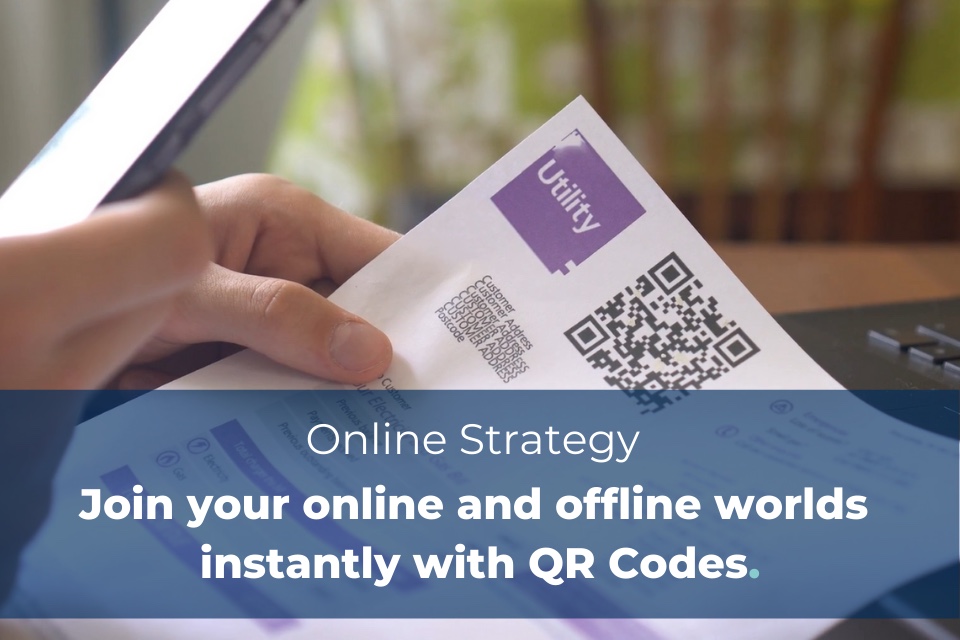
The QR code now provides the perfect mechanism for joining your online and offline worlds, whatever the desired digital action. In this short article, we discuss the numerous benefits to your online strategy of incorporating them into your tangible communications.   

In 2020, society’s need to be ‘contactless’ accelerated somewhat. So much so, the humble (and previously much maligned) QR code has experienced an exponential growth in adoption. 

With in-built QR reading capability on all modern phones and tablets, scanning a QR Code is now a much quicker journey than launching a browser and attempting to accurately type the URL – or searching for a brand in Google, landing on their homepage and hunting out the relevant page or piece of information, that you actually wanted. 

Reduce PPC Costs by driving direct traffic 

On the subject of paid search, QR Codes allow you to reserve PPC spend for the searchers who truly need a nudge, by creating a direct link between your offline communication and digital destinations and you could save your business a considerable about of marketing budget.

Many users will google your brand name, click on you paid advertising and cost you money – remove this possibility by simply adding a QR code. 

Bridge your online and offline worlds with a new level of dynamism for print

Direct Mail has time and time again been proven to offer superior cut through, with recent figures from JICMail’s Q3 2020 report showing a 33% increase in in digital actions prompted by mail – but how many of these responses were driven by a QR Code? 

With all the above advances, QR Codes now offer you the chance to present a seamless transition into your online world, moving your customers from offline consideration into online action and conversion. 

Consider the power of an abandoned basket mailing received 48 hours after browsing and featuring an enticing offer and QR codes for the individual products browsed. 

One simple scan and your customer is online, reviewing their ‘basket’ and just a click away from checkout. 

Generate a multichannel view for more effective digital marketing 

Creating a link between your online and offline worlds will also fuel your digital marketing efforts – customers or prospects who previously hadn’t engaged online may now do so, identifying themselves via their device and enabling retargeting and programmatic display advertising. 

Collect valuable insight through reporting 

Knowing who scanned, when they scanned and the region of where they scanned is incredibly powerful insight, which enables you to capitalise on live opportunities as you know who is in market, right now.

Reporting such as this also enables continuous improvement, as response data can power enhanced targeting of your door drop and partially addressed acquisition campaigns. 

Bring Your Customers Together with QR Codes

Like many, your customers may be feeling a level of uncertainty over whether they will be able to see friends, family and loved ones this Christmas and beyond; as the fight to control COVID-19 before the roll out of vaccines continues and restrictions on social gatherings and travel so frequently change.  

Our range of flexible options means you can either add QR codes to your existing format, or for added effect, incorporate them into one of our many innovative and engaging direct mail formats, as a gift tag. 

The process is simple:

  1. Your customer visits the PURL printed on their mailing
  2. Records their video message on their chosen device
  3. Uploads their video message into their PURL
  4. Applies their QR gift tag to the present, before posting
  5. When the present is delivered, the recipient simply scans the QR code which then automatically to watch the video message

Find more information here

Test a QR Code and receive an incentive discount on your next campaign!

Why not take advantage of a live incentive and include a QR code on your next Advertising Mail or Business Mail campaigns, for 15% and 30% discounts respectively?

Below are just some of the endless possibilities for driving your customers to take digital actions:

  • Drive to coupon
  • Visit web site
  • Send to Geo-location
  • Play an mp3 jingle or message
  • Visit product page
  • Drive to data capture page
  • Link to event details
  • Get a review or rating

Get in touch If you’d like to speak to our expert team and discuss how QR Codes can help you engage with customers online, we’ll be in touch shortly!